Helsinki-Vantaa Airport and Surrounding Area from the Air
Our flight is coming to an end, and we can already see the airport grounds of the Finnish capital under our wings. There are three runways here, two of which are 3,500 and 3,060 meters long, running parallel and used for simultaneous takeoffs and landings. The third runway is perpendicular and 2,901 meters long. All of the runways can accommodate various types of aircraft, including the super-heavy A-380.

Compared to the gigantic hubs of the megacities of Southern and Central Europe, Finland's main air port looks quite small. In the center is the international terminal, and on the right is the domestic terminal.

To the right of the passenger terminal building, you can see the cargo terminal. In the center of the lower right quadrant of the frame, you can see two hangars standing on a ledge just below a tall building. This is the Finnish National Aviation Museum, which you can visit if you have a couple of hours between flights. It is a 20-minute walk from the terminal building.

For some reason, we weren't allowed to land immediately this time, and we were sent on a waiting loop.

For about 10 minutes, you could explore the neat landscapes of Helsinki's northern suburbs in detail.

It is about 17 km from the city center to the airport, which is already a long way for the compact Finnish capital. Small settlements with one-story buildings can be seen under the wing.

A small quarry where construction materials are extracted and processed on-site.

The outskirts of Helsinki are a chaotic scattering of one-storey houses, built with maximum preservation of the environment. Finns are very fond of their nature, and do not think of life outside of it - even in the center of the capital there are islands of natural landscapes.

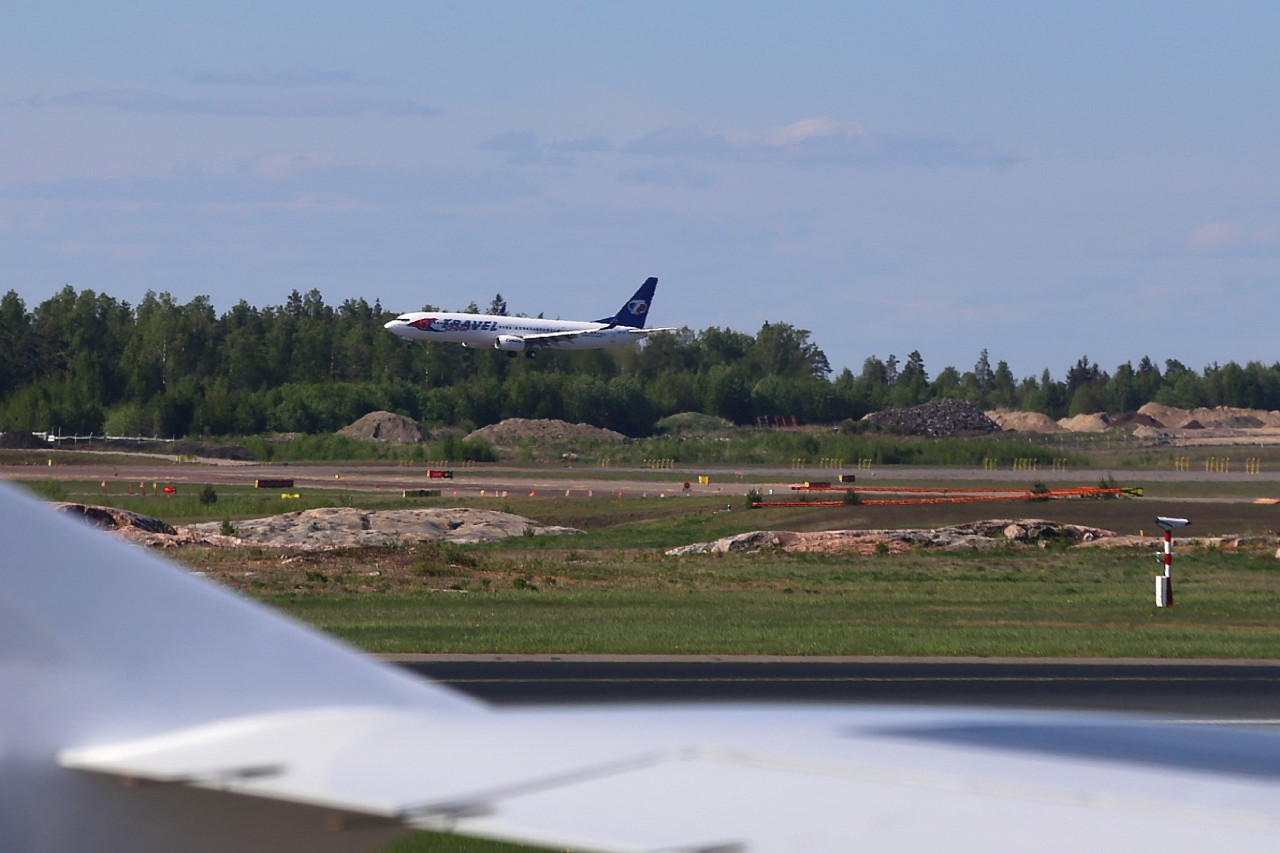
Finally, the plane enters the landing glide path.

The airport in the suburb of Vantaa was built for the 1952 Olympic Games and has since undergone several renovations. Since the late 1960s, the airport has been serving intercontinental flights, and in 1983, it became the first European airport to offer non-stop flights to Japan.
The airport is the base of the national air carrier of Finland. Finnair is positioned as a budget airline, but it does not have baggage restrictions like low-cost airlines. At the same time, the service is quite up to par, the only thing that the standard ticket does not include meals on board. But you can order lunch when buying a ticket or during registration, the cost is within 10-15 euros. Or make do with your own supplies. Water is delivered free of charge throughout the entire flight.

Despite its modest size, Vantaa Airport serves up to 30 million passengers per year and is a low-cost hub for transatlantic and other long-distance flights. Compared to other airports, it is surprisingly deserted. Thanks to its efficient layout and modern facilities, the time spent on pre-flight and post-flight procedures is minimized, and the average transfer time is 35 minutes, which is a record in its own right. The airport has been recognized as the best in Europe on several occasions.

In front of the airport building, there are rows of bus stops, which are easy to get lost in. This diagram shows two main ways to get to the city - by train and by bus. The train is faster, but the buses run more frequently, so I chose the second option. The regular city bus route 615 takes about 50 minutes to reach the Central Station, and the ticket costs 5.5 euros. If you want to travel faster, you can take the Aeroexpress train, which takes 25 minutes and costs 7 euros. I had nothing to rush off to, as I still had more than 10 hours before my flight to Yekaterinburg.
