Mikoyan MiG-29GT, Krakow
The main impetus for the development of the MiG-29 was the USSR’s response to the new generation of American F-15 Eagle fighter jets and the F-16 Fighting Falcon program, which effectively nullified the combat capabilities of the MiG-21 and MiG-23. In addition, real combat experience in Vietnam and the Middle East refuted the 1950s theory about long-range missile combat and proved that maneuverability, engine response, and visual visibility are of crucial importance. Based on this, in 1969 the Soviet General Staff issued a task to develop a promising front-line fighter. Here, too, Soviet strategists were following in the wake of the United States, which divided fighters and attack aircraft into light and heavy types. This is how the light MiG-29 (NATO reporting name is Fulcrum) and the heavy Su-27 (Flanker) came into being. The integral aerodynamic configuration, in which the fuselage seamlessly merges with the wing and generates additional lift, was also borrowed from new American fighter aircraft, which had been slightly modified at TsAGI. As a result, the two new Soviet fighters are surprisingly similar in silhouette and differ only in size.

Preliminary design work began in various design bureaus in 1971, and a year later, the Mikoyan Design Bureau’s project, designated "Product 9", won the competition against the Sukhoi Design Bureau and the Yakovlev Design Bureau. The active phase of detailed design began, and on October 6, 1977, the design bureau’s chief pilot, Alexander Fedotov, took the first prototype of the aircraft into the air for the first time. Between 1979 and 1982, two dozen prototypes were built and subjected to endless tests. The designers faced major problems — ranging from mechanical strength issues, which led to the destruction of the empennage, to engine problems. As a result, two prototypes crashed, and the pilots successfully ejected. Serial production began in 1982; in July 1983, the first serial fighters began to be delivered to the operational units of the USSR Air Force. Nevertheless, it took another four years before the aircraft were adopted for service. Over the entire production period, more than 1,600 MiG-29 fighter jets of various modifications were produced; the aircraft was supplied to more than 30 countries on four continents, and many countries still operate them today. The last batch, ordered by Myanmar, was built in 2013. Interestingly, even the United States is among the buyers; in 1997, it purchased 21 MiG-29 fighter jets from Moldova. The purpose of the deal was to prevent the aircraft from falling into the hands of Iran. Some of the planes were sent to a research center for thorough study, while others were restored to flying condition and used in training exercises.

This aircraft was in service for more than a quarter of a century, serving in the air forces of three countries. In 1988, it was assembled in the USSR at the Gorky Aircraft Plant for the air force of East Germany, where it was based at the Preschen airbase as part of the JG-3 fighter squadron. In total, the GDR received 20 combat MiG-29As and 4 combat training MiG-29UBs. After the unification of Germany in October 1990, all the armaments of the GDR were transferred to the Luftwaffe (the air force of the FRG). The old aircraft were immediately decommissioned; the MiG-29s entered service 1–2 years before the fall of the Berlin Wall, and they were upgraded to NATO standards, receiving the designation MiG-29GT. The modernization of the German MiG-29s was aimed at integrating Soviet fighter jets into the overall NATO air defence structure. The work was carried out by the German aircraft manufacturing company DASA (later incorporated into Airbus) in collaboration with the Russian aircraft manufacturing corporation "MiG". The aircraft were equipped with American GPS satellite navigation receivers (Magnavox) and TACAN radio navigation system equipment (AN/ARN-118). This enabled German pilots to fly along international civilian and military routes in Europe. The radio stations were replaced with Collins AN/ARC-182 VHF transmitters that support encrypted NATO communication channels. The Soviet system of state identification "Friend-foe" was also completely replaced by the Western IFF (Stratoflex/Cossor SRM 1051 type). In the cockpit, all instrument scales were converted from the usual meters and kilometers for Soviet aviation to the NATO-accepted feet, knots, and miles. All markings and inscriptions on the dashboards have been translated into English. To increase the flight range, additional pylons were installed under the wings. The fighters gained the ability to carry two external fuel tanks, each with a capacity of 1,150 liters, in addition to the standard under-fuselage tank. The onboard engine control computers for the RD-33 engines were reconfigured to increase their service life between overhauls, although this slightly reduced the maximum thrust during afterburner operation. At the same time, the armament system and the onboard radar "Rubin" remained unchanged: the GDR had significant stocks of Soviet R-73 and R-27 missiles in its warehouses, and converting the aircraft to use American AIM-120 AMRAAM or AIM-9 Sidewinder missiles would have been too expensive. The fighter continued to fly as part of the 73rd Fighter Squadron Steinhoff at Lage Air Base. In 2002, Germany transferred 22 remaining MiG-29 fighter jets to Poland for a nominal fee of 1 euro per aircraft. In December 2003, this aircraft joined the Polish Air Force, receiving the tail number 4115. The aircraft was on combat duty at the 22nd Tactical Aviation Base in Malbork. In 2014, the aircraft’s airframe service life expired, and it was taken out of service and transferred to the Polish Aviation Museum in Kraków.

The MiG-29 fighter is equipped with a power plant consisting of two twin-circuit turbojet engines with an afterburner RD-33 developed by the OKB im. Klimova under the leadership of Sergey Sarkisov. The engines are located in engine nacelles with axle spacing, which ensures high survivability of the aircraft and excellent maneuverability. The RD-33 engine was created in the 1970s and 1980s for the front-line fighter for gaining air supremacy. This required good throttle response and gas-dynamic stability during intense maneuvering. The Soviet designers based their work on the concept of American third-generation Pratt & Whitney TF30 engines, which were installed on the F-111 and F-14A. Their design, featuring a common afterburner for both stages, provided efficiency in cruise mode and enormous thrust during afterburning. The Klimov Design Bureau had extensive experience in developing turboshaft engines for helicopters and liquid-propellant rocket engines, as well as well-established mathematical models of gas dynamics, methods for designing high-temperature turbines, and technologies for heat-resistant alloys.

Soviet designers achieved excellent performance: the RD-33 transition from idle to maximum power took only 3-4 seconds, and to afterburner - 4-5 seconds. For a combat fighter, this is critically important when abruptly breaking out of an attack or evading a missile. The design of the compressor and automation makes the RD-33 extremely resistant to abrupt movements of the engine control stick. The pilot can move it in any direction without the risk of stalling or disrupting the airflow. By the way, Ukrainian pilots successfully use this feature when hunting drones. There is a video online showing a MiG knocking down a Shahed drone with a shock wave caused by a sudden acceleration, without expending ammunition.

The MiG-29 was designed to operate from front-line, poorly prepared airfields. During takeoff and landing, the lower air intakes are completely closed by titanium shutters, and air flows in through louvers in the upper part of the wing. The RD-33 “handles” such a complex air flow distribution regime without losing stability. The designers also paid attention to ease of maintenance: the modular design (also borrowed from the Americans) allows damaged or worn-out components (for example, a nozzle or a fan) to be replaced right in the field, without having to send the entire engine back to the manufacturer.

Naturally, all these achievements have a downside — Soviet engines have always been characterized by lower fuel efficiency and service life compared to their Western counterparts. The reason for this lies in the extremely low technological level of production, which negates the good design solutions. The RD-33 engines are very fuel-hungry, as fuel does not burn completely in non-afterburner modes, which is why MiG-29 aircraft leave a noticeable trail of black smoke. Early series had a service life between repairs of only 300–400 hours, while the full designated service life was 800–1000 hours. Taking this into account, Soviet strategists anticipated a short war with enormous losses, which is why the aircraft’s service life was planned to be short. However, in peacetime, this led to constant repairs, overloading factory capacities and diverting skilled personnel. Over time, these problems were addressed, but overall, these issues have not disappeared to this day-rather, they have become more pronounced. The main characteristics of the RD-33 engine are: thrust at maximum mode: 5040 kgf (50.4 kN), in afterburner: 2 × 8300 kgf (81–83 kN). Dry weight of one engine: about 1055 kg.

In front of the cockpit windshield is a КОЛС (Quantum Opto-Location System); in the West, this class of systems is called IRST (Infrared Search and Track). It is used as a heat-seeking direction finder and laser rangefinder, allowing the radar to be turned off, as its radiation would unmask the aircraft. Below it is an air pressure receiver.

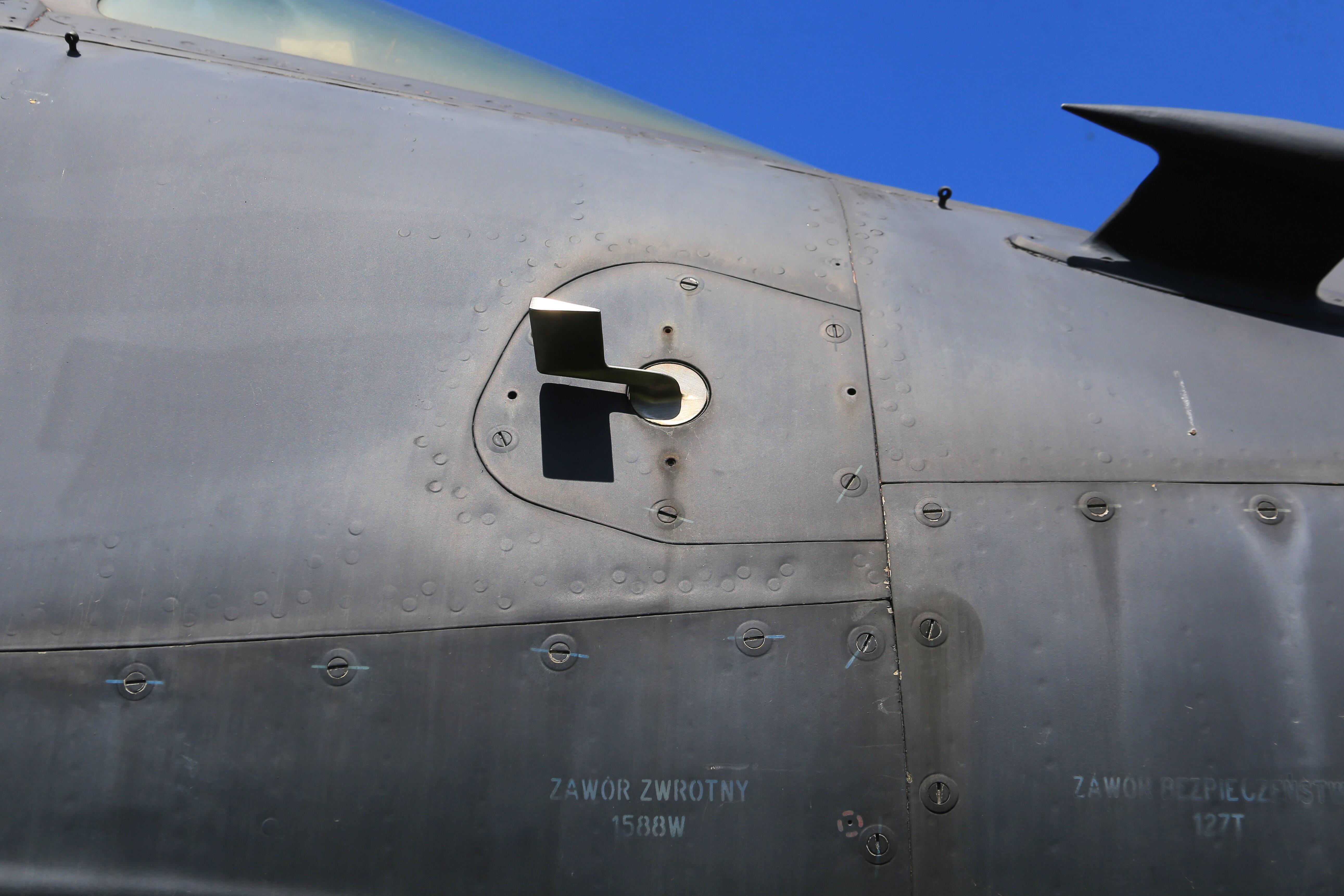
A little further on, we see the angle of attack sensor vane. This is a simple and reliable automatic component that prevents a stall.
The right landing gear well with a landing light. Large-diameter wheels theoretically allow flying even from unpaved runways, but in practice this is not used.

Numerous hydraulic lines and valves are visible in the niche. The MiG-29 did not have electro-digital control systems, unlike its main competitor, the F-16.

The underwing pylon for mounting weapons. The MiG-29 has three hardpoints under each wing. The aircraft can carry two or more tons of combat load: air-to-air missiles, bombs of various types, and electronic warfare units. Pay attention to the inscriptions - they are in Polish. Initially, they were in Russian; in the FRG, they were replaced with English ones in accordance with NATO standards, and the Poles, in turn, added their own.

One of the pylons is open, revealing a rather complex uncoupling mechanism.

The lower flap is used as an air brake during landing and while maneuvering. Above it is a compartment for the drogue parachute, which reduces the landing run.
