Tower of the Old Town Hall (Věž Staroměstské radnice)
Almost immediately after the establishment of the Town Hall and the purchase of the house of merchant Volflin to house it in 1338, the construction of a stone tower began by its eastern wall. Such expensive structures in the Middle Ages were built not at all for beauty or status, but for purely practical purposes: watchmen monitored the fire situation around the clock, and during endless wars they timely notified the garrison of the enemy's approach. With special trumpet signals at dawn and at sunset, the watchman notified the guards of the need to open or lock the gates of the Prague fortifications. In addition, the watchmen informed the townspeople of the arrival of a new hour. The trumpeter sequentially gave signals from each side of the tower, thus all townspeople heard him. This tradition was preserved even after the appearance of a clock with a bell chime on the tower.

The construction of such a complex structure was neither fast nor cheap, so it dragged on for a quarter of a century and ended in 1364. The tower has a classic medieval frame-and-wall structure made of hewn blocks of Prague sandstone and limestone (opuka) with rubble infill. The cross-section at the base is 8.37×7.91 meters, the thickness of the walls in the lower part exceeds two meters, which made it possible to reach a height of almost 70 meters without reinforcing the foundation. A stone spiral staircase leads to the observation deck. For many centuries, the tower became the tallest structure in the Old Town.
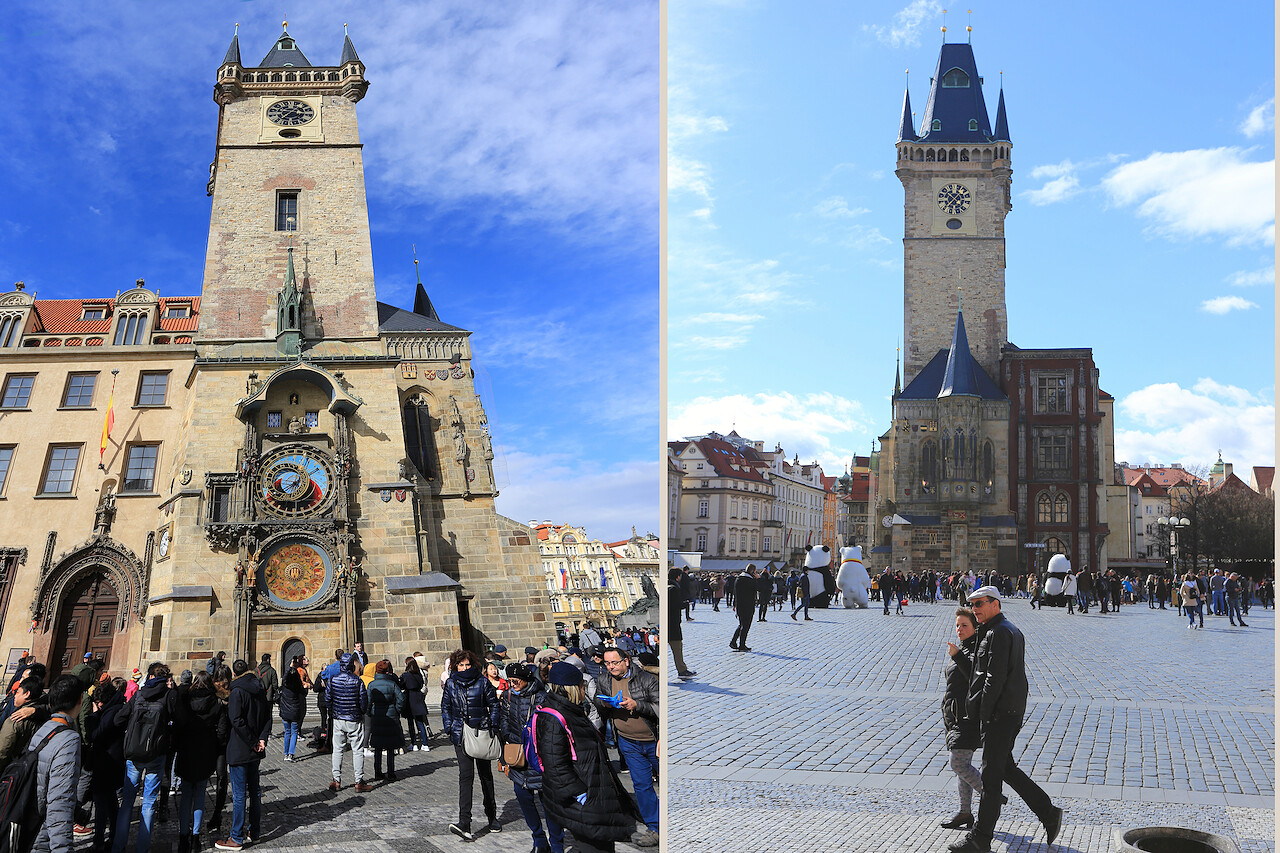
In 1381, a town hall chapel consecrated in honor of the Virgin Mary and Czech patron saints was built into the ground floor of the eastern wall of the tower; in 1410, the installation of the Orloj astronomical clock began on the southern facade of the tower (I will tell you about these objects in detail in future articles). In 1807, the upper tier was rebuilt: a new tower clock was installed, the observation gallery and the hipped roof were updated. Upon completion of these works, access to the gallery was opened, and the tower became one of the first tourist attractions in Prague. In the final days of World War II, during the Prague Uprising, the town hall found itself at the epicenter of street fighting. On May 8, 1945, after German artillery shelling, a strong fire broke out in the building. The fire destroyed the roof of the tower, burned the wooden figures of the apostles, and collapsed the dial of the astronomical clock. The new authorities declared the restoration of the symbol of Prague a priority task, and already in 1948 the tower took on its usual appearance.
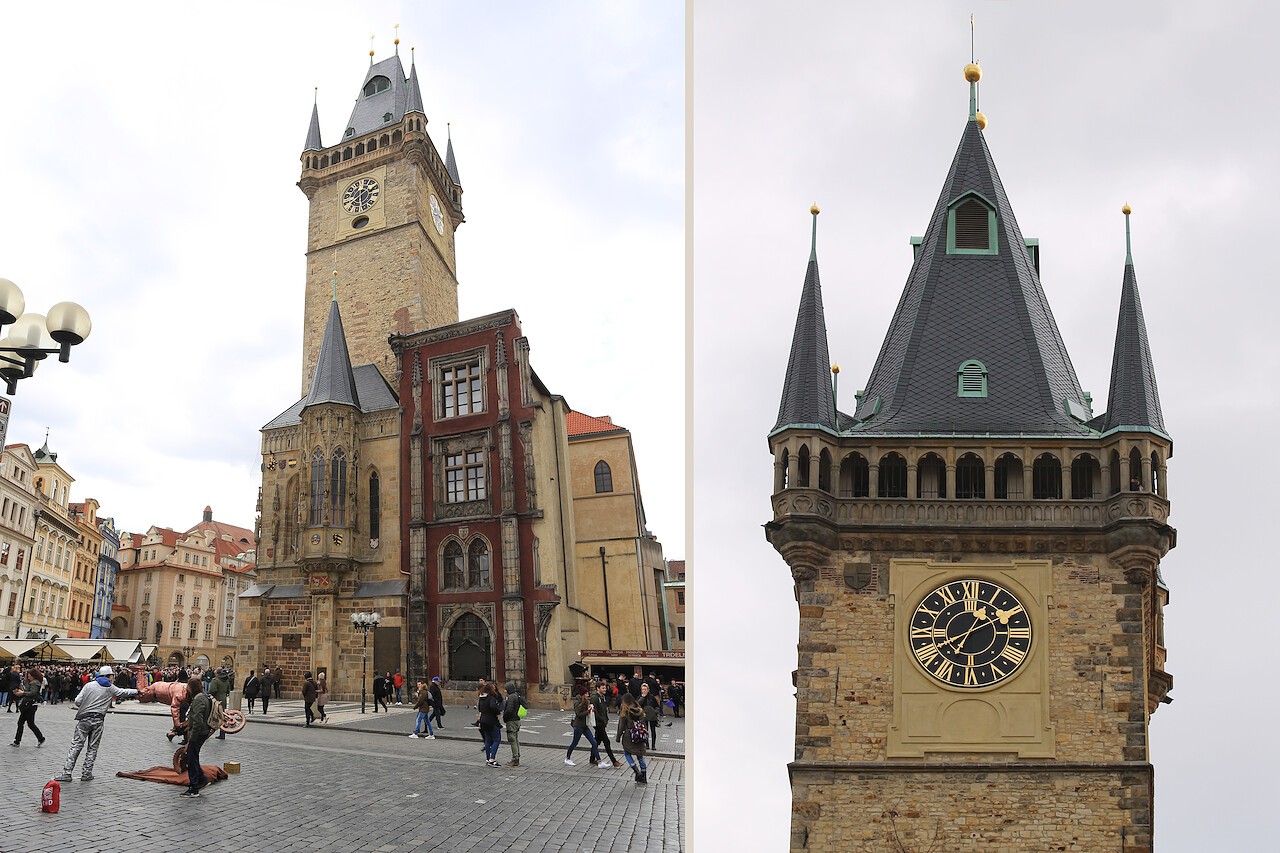
Several legends are associated with the tower: on June 21, 1621, right at the foot of the Old Town Hall Tower, 27 leaders of the anti-Habsburg uprising of the Bohemian estates were executed. The places of their execution are still marked by 27 white crosses on the cobblestones of the square. Every year on the night of June 21, the shadows of the executed nobles gather by the town hall tower, and then silently go to the Church of Our Lady before Týn to check whether the executioner's sword, which, according to legend, is kept there as a symbol of future revenge, has fallen from the sky. Another mystical story tells of an old trumpeter who loved his tower so much that even after death his spirit remained on the observation gallery. Since then, on quiet foggy nights at the foot, one can supposedly hear muffled sounds of a trumpet.
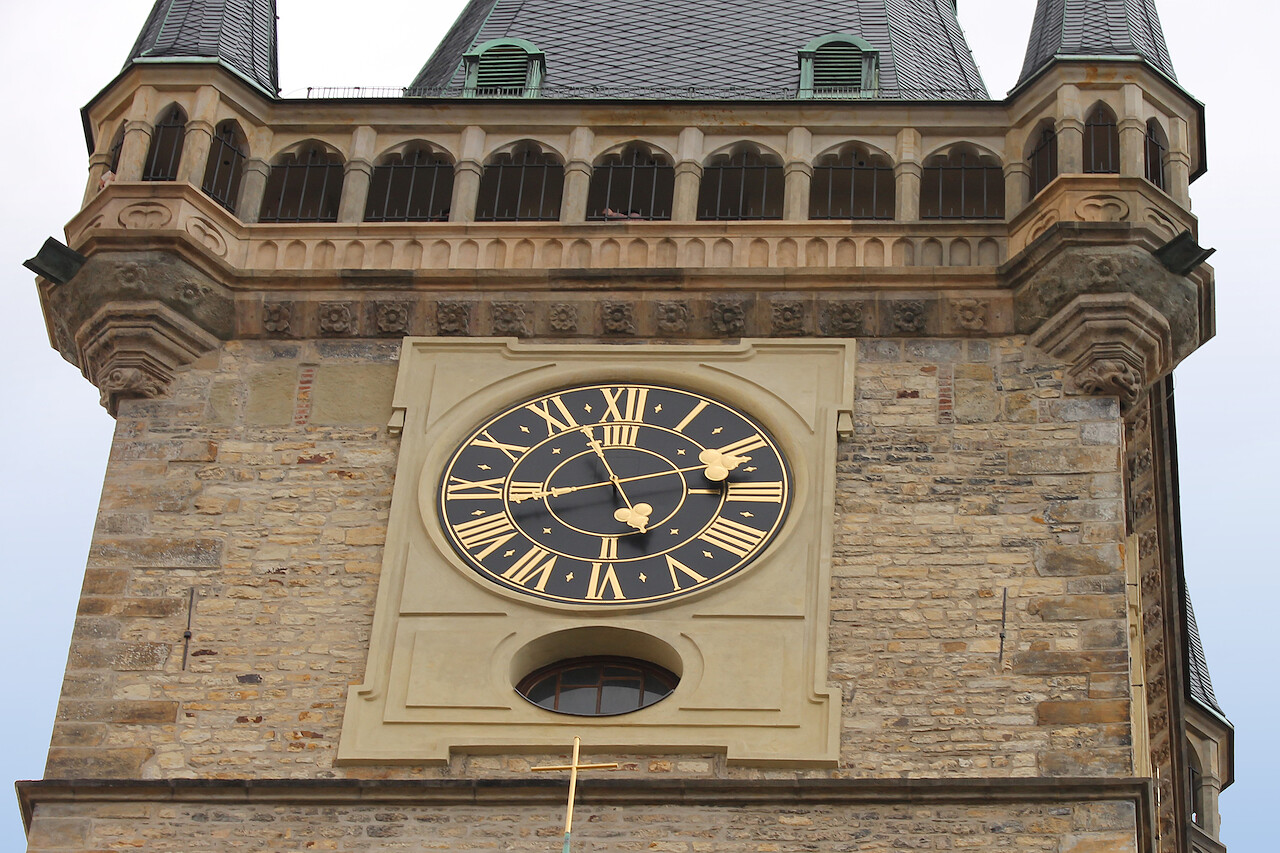
n 1999, an elevator designed by Czech architect Marek Houska was built inside the tower. The futuristic glass-and-metal shaft is inscribed directly into the empty space in the center of the ancient stairwell without disturbing the medieval masonry and received the name "space elevator" (kosmický výtah). The Old Town Hall Tower became the only medieval observation tower in Prague with fully barrier-free access to the top. You can listen to live trumpet signals performed by a trumpeter in historical costume at the top of every hour, and if you are on the observation gallery at that time, you will see him up close. Access to the gallery is open daily from 9:00 or 10:00 AM depending on the season, a visit costs 350 Czech korunas (CZK) for adults, tickets are sold at the tourist information center in the lobby of the main entrance (in Wolflin's House).