Parque da Liberdade, Sintra
Rua Maria Eugenia Reis Ferreira Navarro ends at a green massif that looks like an exotic forest. The Sintra City Park occupies almost half of the territory of the Old Town.

In 1935, the city authorities of Sintra realized that, despite the abundance of royal palaces and private forest estates, the city lacked a regular public park for the enjoyment of residents and tourists. In 1936, the Sintra Tourism Commission purchased the site of a former private estate (known as Valença Park) on a picturesque slope along the Volta do Duche road. The landscaping work took about a year. In July 1937, the park was торжественно opened with the participation of the President of Portugal, General O’Hara. Carmonas. During the planning, the natural landscape, streams, and more than 50 species of trees and exotic plants were preserved, supplemented with paved paths and terraces.

The park’s core consists of spreading oaks, chestnuts, plane trees, cedars, cypresses, and magnolias. On the slopes, evergreen species typical of Sintra grow — the bay laurel, the strawberry tree (Arbutus unedo), holly, the Portuguese cherry laurel (Prunus lusitanica), and the cork oak. Large bushes of azaleas and Asian camellias are planted in the shade of the tall trees; they bloom particularly profusely from late winter to mid‑spring. The high humidity in the shady hollows allows tall tree ferns (as in one of your previous photos), various palms, and bamboo to grow freely. Along the stone paths and at the foot of the moss‑covered boulders, flowering orange clivias, hydrangeas, agapanthus, and dense borders of ophiopogon (lily‑of‑the‑valley) are planted.

For holding mass events outdoors, the park has an Amphitheater (Anfiteatro), built in the 1930s. Its architecture is styled after ancient structures, which is why it is more commonly known as the Roman Theatre (Teatro Romano). The tiers of spectator seats are made of natural stones, which are covered with smooth marble slabs for the benches. Concerts, theatrical performances, poetry evenings, and cultural festivals of Sintra are held here.

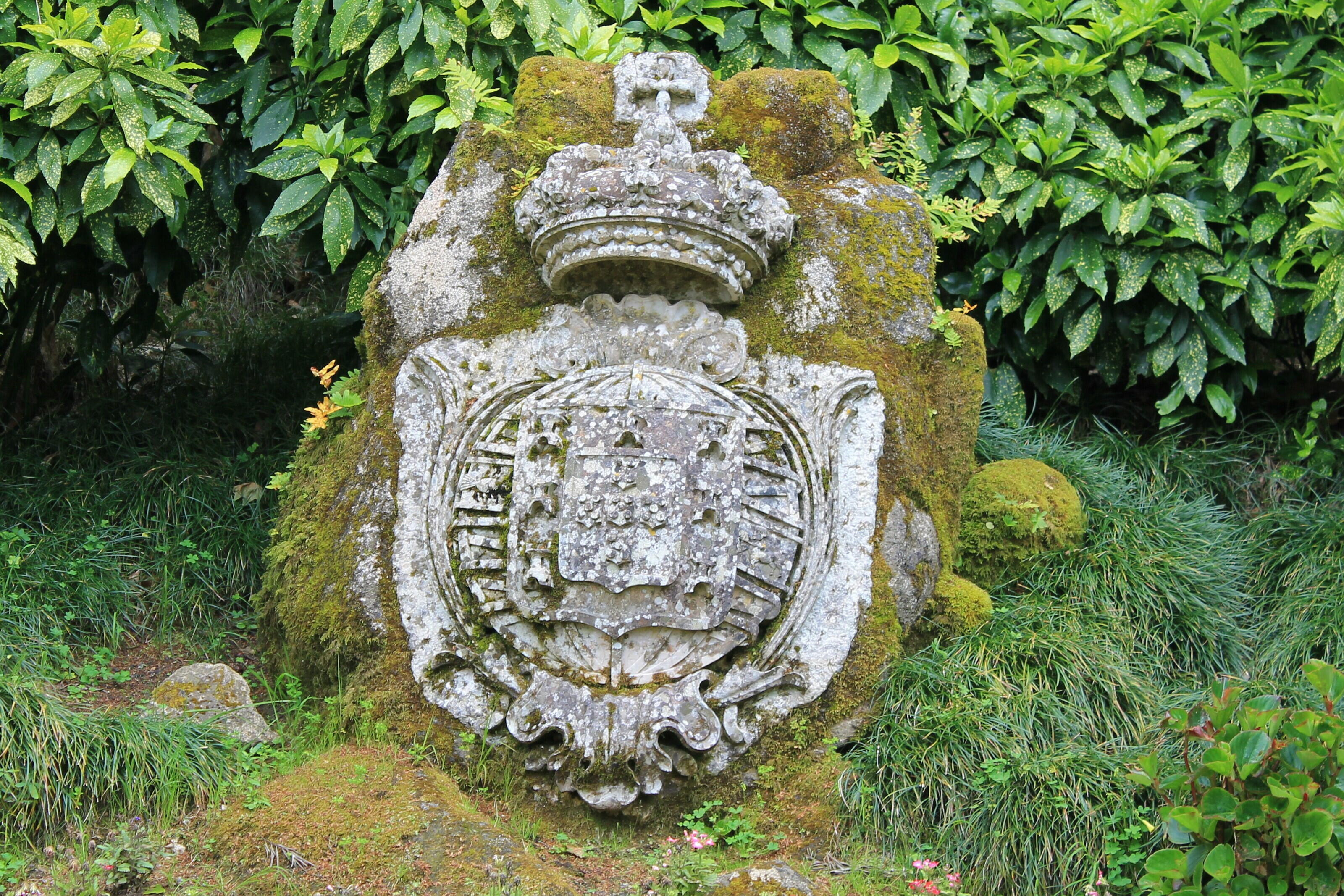
On one of the paths on the slope near the Roman Theatre, you can see a moss‑covered bas‑relief depicting the Royal Coat of Arms of Portugal (Brasão de Armas Reais de Portugal). In the 17th–18th centuries, similar coats of arms decorated the facades of palaces, fountains, city gates, or old royal estates in Sintra. In the early 20th century, Sintra was actively rebuilt; dilapidated houses were demolished, and the municipal authorities used their monumental decor to beautify the city.
In August 1939, the park was equipped with tennis courts and a roller skating rink, which for a long time served as a base for training and matches of the local roller hockey team, a traditional sport for Portugal. In the 21st century, an interactive "Virtual Theater" was opened in the park, telling about the history of relations between Portugal and Japan.

The park features a monument to Dr. Joaquim Nunes Claro (1878-1949), whom the residents of Sintra called the “father of the poor” (pai dos pobres). The well‑known doctor treated indigent patients for free and allocated considerable funds from his personal income for charity. In addition to healing, he was a subtle lyrical poet, during his lifetime he published a collection of poems "Ashes of Hours" (A Cinza das Horas) and a poem "Prayer to Hunger" (Oração à Fome), and after his death the municipality of Sintra published a collection of his sonnets. The bronze bust on a natural granite boulder was created by the famous Portuguese sculptor Pedro Anjos Teixeira. The monument was erected in May 1965 using funds raised by the public, collected on the initiative of the local newspaper Jornal de Sintra. I can note that nowhere else but in Portugal is there such a large number of monuments to doctors; the Portuguese reverently honor the memory of the people who freed them from illness or saved them from death.

When creating the park, the natural vegetation was supplemented with rare and exotic species, including those from warm countries.

Since it can be quite cold in Sintra in winter, an Orangery (Estufe) was built to preserve them.

Next to the greenhouse building, there is a small cozy courtyard in the Japanese style, with a small pond and an arch bridge.

At the end of the 20th century, a mini‑zoo was built — it’s an enclosure with a small lake where chickens, roosters, geese and ducks live.

The Muscovy duck, more commonly known as the Indian duck (Cairina moschata).

The white bird is a mulard, a hybrid of the Muscovy and Peking duck.

A domestic goose with characteristic features of a Chinese breed, originating from the wild swan goose.

Walking along the path, I noticed a bright sculpture among the greenery and stones, depicting some kind of exotic animal.

It turned out that there are many such sculptures in the park. Their bright silhouettes contrast well with the dense greenery of the park, creating a festive look.

There is no information about the author of these sculptures, but they were clearly created by a cheerful person. The blue elephant and the red bull with bright spots are particularly pleasing to the eye.

A lizard and a frog next to the stone coat of arms of Sintra.

Camel and rhinoceros.

And this, apparently, is some kind of prehistoric lizard.

In the lower part of the park, there is a small white house in a traditional Portuguese style. This is the service room for the park rangers, as well as a public toilet.
