Canarias Heavy Cruiser
The legendary Spanish cruiser, known mainly for its participation in the Civil War, where it was the flagship of the nationalist fleet. Canarias played a huge role in the naval war: in September 1936, it broke through the blockade of the Strait of Gibraltar, ensuring the transfer of troops from Africa, in early 1937 it provided artillery support during the siege of Malaga, in the battle of Cape Palos on March 6, 1938, it received a torpedo on board, but remained operational, in March 1939 participated in the unsuccessful landing attempt in Cartagena. Throughout the war, the cruiser raided the Mediterranean Sea and the Atlantic, disrupting the republic's supply, capturing and destroying 34 ships. During World War II, Spain remained neutral, but on May 26, 1941, it responded to an unofficial request from Grand Admiral Raeder to rescue the crew from the damaged battleship Bismarck. Franco sent the cruiser Canarias and two destroyers to the Atlantic, but in three days of searching, they found only two bodies of dead German sailors at the battlefield. His post-war service was marked by his participation in the colonial war against Morocco (the Infi War) in 1957-1958 and the operation to liberate the Santa Maria liner seized by extremists in January 1961. The cruiser remained the flagship of the Spanish fleet until the 70s.
In 1969, the cruiser embarked on its last repair. Initially, it was planned to equip it with missile weapons, but an inspection of the hull and power plant forced them to abandon this idea, so they limited themselves to installing four paired 40mm Bofors anti-aircraft guns. Since then, the cruiser has been used as a training ship and fleet headquarters, in addition to making official visits. In Spain, the ship was popular and its every port call turned into a celebration. Nevertheless, in 1975 it was decided to send the ship to reserve, as its boilers and turbines were in poor condition, and it was very expensive to maintain a crew of 800 people. On December 17, the ceremony of the last lowering of the flag took place, and in 1978 it was withdrawn from the fleet. While the ship was moored at the Ferrol arsenal in Galicia, various Spanish cities (Barcelona, Cadiz, Ferrol, Santa Cruz de Tenerife) tried to negotiate its purchase to create a museum ship, but Spain entered a period of economic crisis and in 1980 the ship was auctioned off for cutting. Now the iconic name Canarias is carried by the Santa Maria-class missile frigate with the tail number F-86. A curious fact: some Soviet sources indicate that the cruiser is named after the German Admiral Canaris, although, of course, it is named after the Canary Islands, and its sister ship Bolearias, respectively, in honor of the Bolearic Islands.
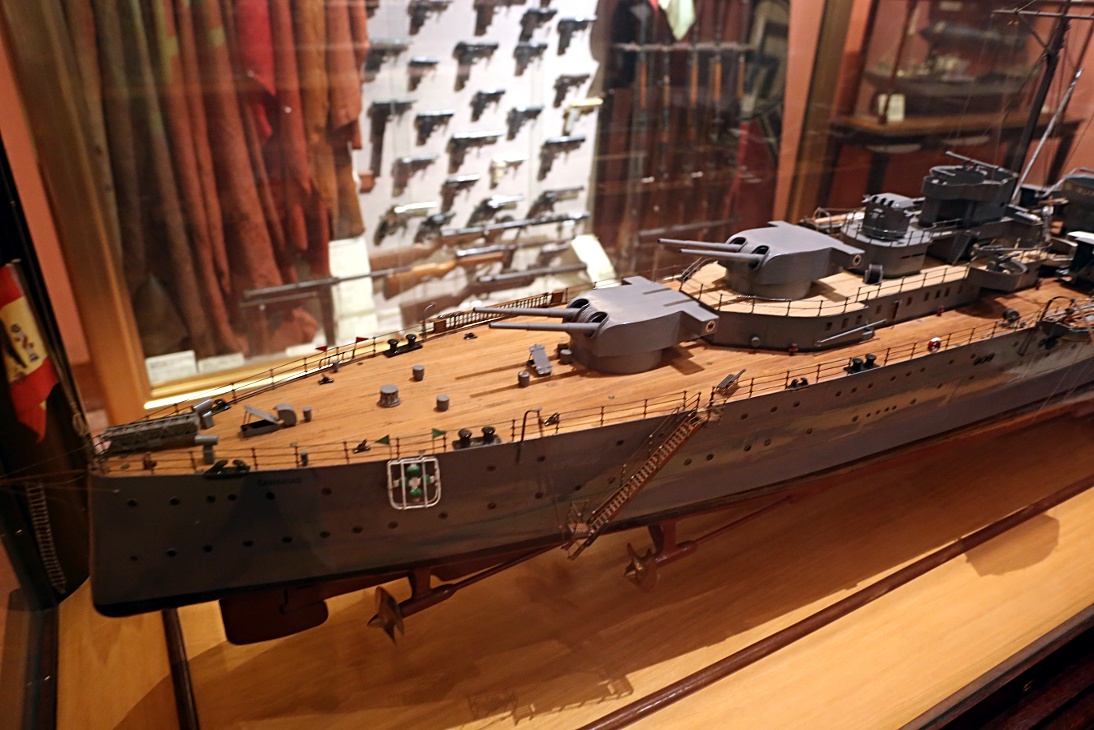
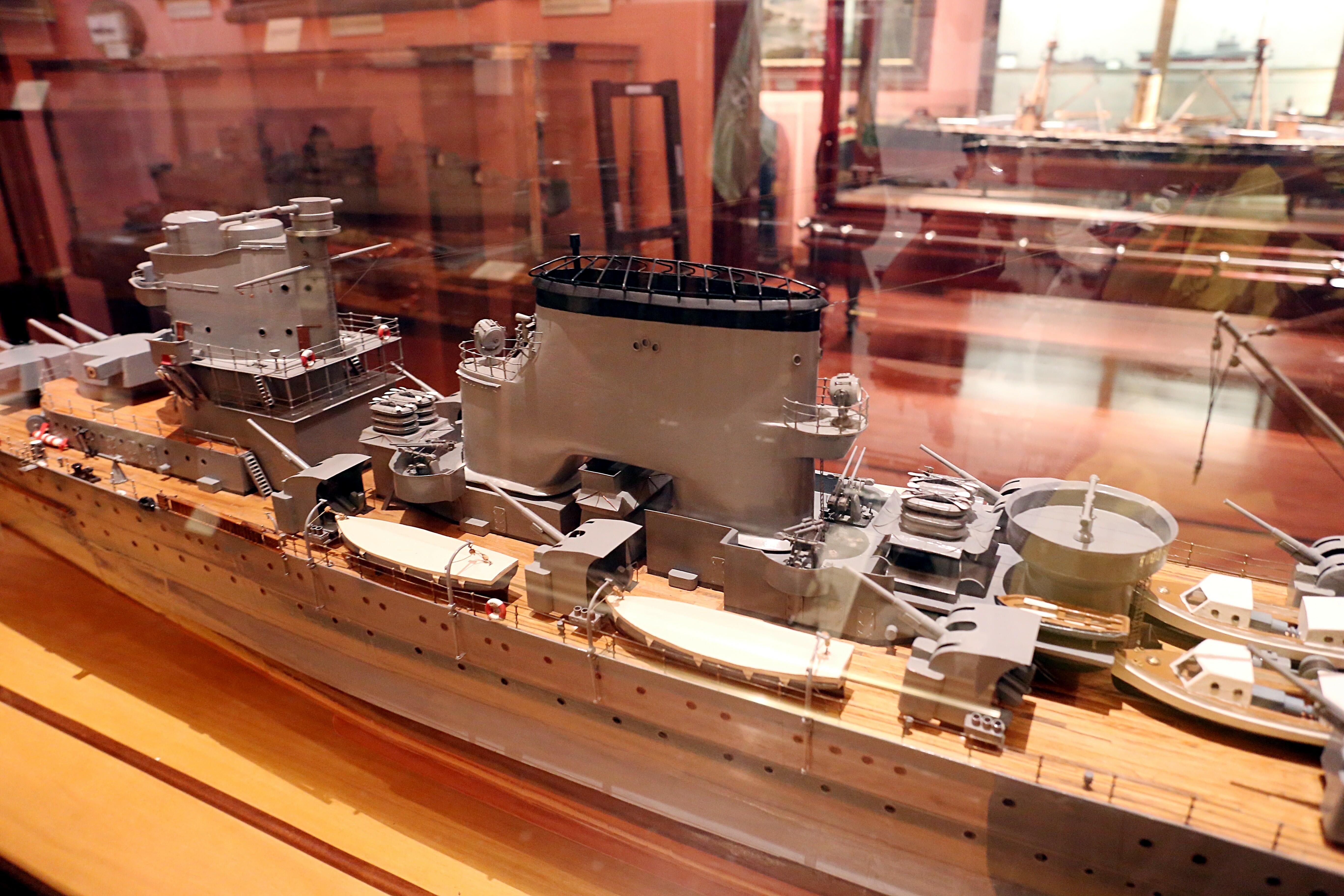
The history of the construction of this class of cruisers is no less interesting. In 1926, the government of General Miguel Primo de Rivera approved a large-scale naval program, which was to be led by three heavy cruisers. The British County-class cruisers were chosen as the basis. In 1922, the Washington Naval Agreement was signed, limiting the displacement of warships to 10,000 tons, which led to the emergence of the so-called "Washington Cruisers." Spain did not sign this agreement, but did not go beyond its scope. The cruisers were built at the Sociedad Española de Construcciones Navales shipyard in the city of El Ferrol in Galicia, the shipyard was a branch of the British company Vickers & Elswick. Information is circulating on the Internet that the author of the Spanish cruiser project was allegedly the famous shipbuilder Sir Philip Watts, renowned as the creator of the epoch-making Dreadnought, but this is not true, since Watts died in 1926 and designed only battleships. The author of the Counti class project was Sir Eustace Tennyson d'Eyncourt. Spanish engineers made some changes to the British design, strengthening the armor belt around the artillery cellars. Another innovation was one huge chimney instead of three, which gave the cruiser a unique silhouette. In fact, this decision turned out to be unsuccessful, the smoke blew on the bridges of the rangefinder posts, limited the sectors of anti-aircraft artillery fire, and the huge sail made it difficult to keep the course in a strong crosswind. During the 1952 modernization, the monstrous structure was removed and two classic chimneys were installed. Construction of the cruiser began on August 15, 1928, and the hull was launched on May 28, 1931. Due to the political and economic turmoil, the completion was greatly delayed. During the nationalist rebellion, the cruiser was captured in an unfinished state and hastily commissioned on October 1, 1936.
Characteristics of the cruiser: Displacement 10,000 tons (standard) / 13 496 tons (full), Length 193.9 m Width 19.52 m, draft 6.51 m. The power plant included 8 Yarrow boilers and 4 Parsons turbines with a total capacity of 90,000 hp, powered by 4 propellers. The ship had a maximum speed of 33 knots. The fuel reserve (fuel oil) was a maximum of 2,800 tons, which provided a cruising range of 8,000 nautical miles at a speed of 15 knots. Armament: main caliber 8 × 8-inch (203 mm) Vickers guns in four twin enclosed turrets, 8 × 4.7-inch (119 mm) guns in open turrets. Anti-aircraft artillery 12 40 mm guns (QF 2-pounder, better known as pom-pom) and 3 20 mm submachine guns. Armor protection: 51 mm armor belt, 25-38 mm deck, 102 mm ammunition magazines. The crew is 800 people.
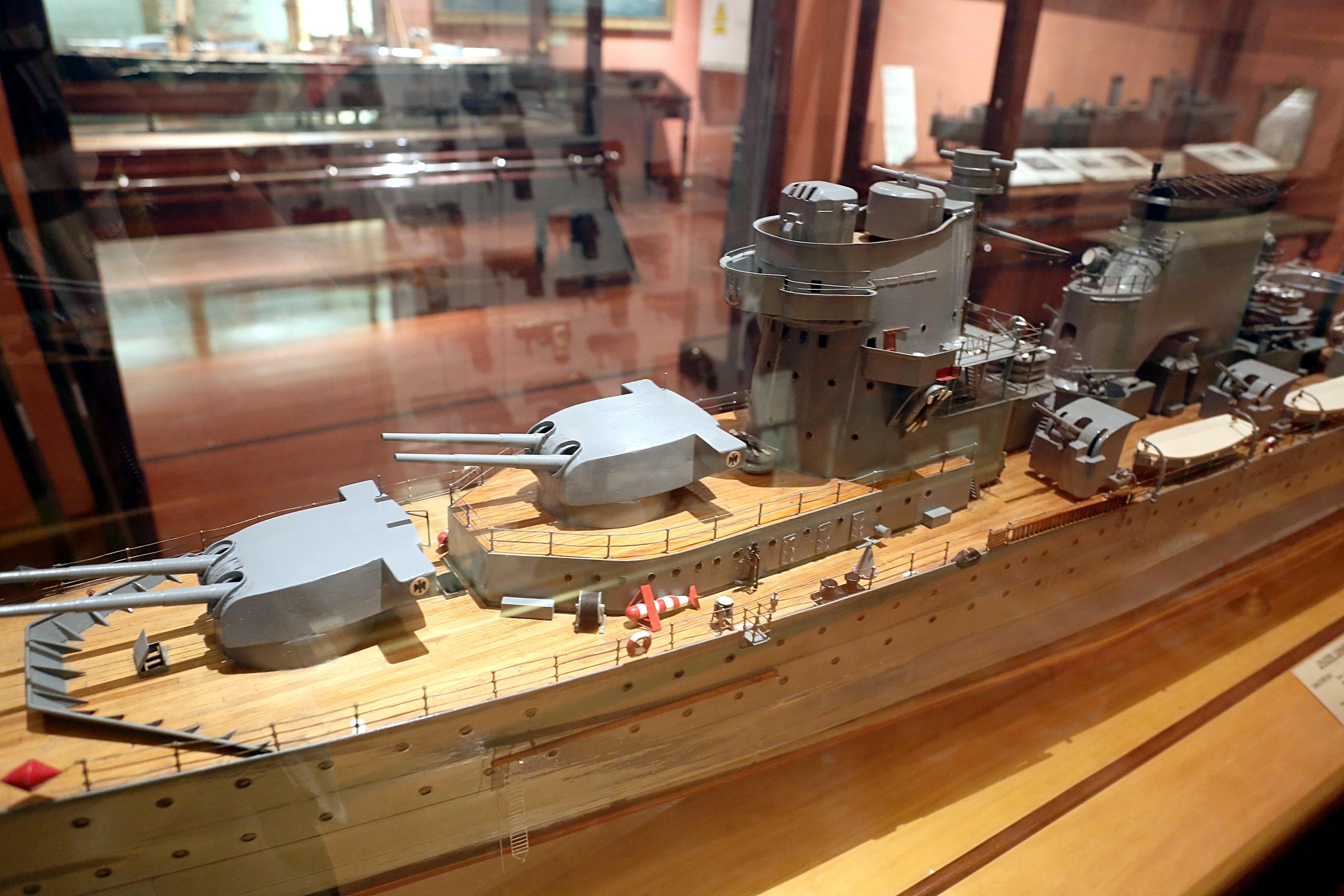
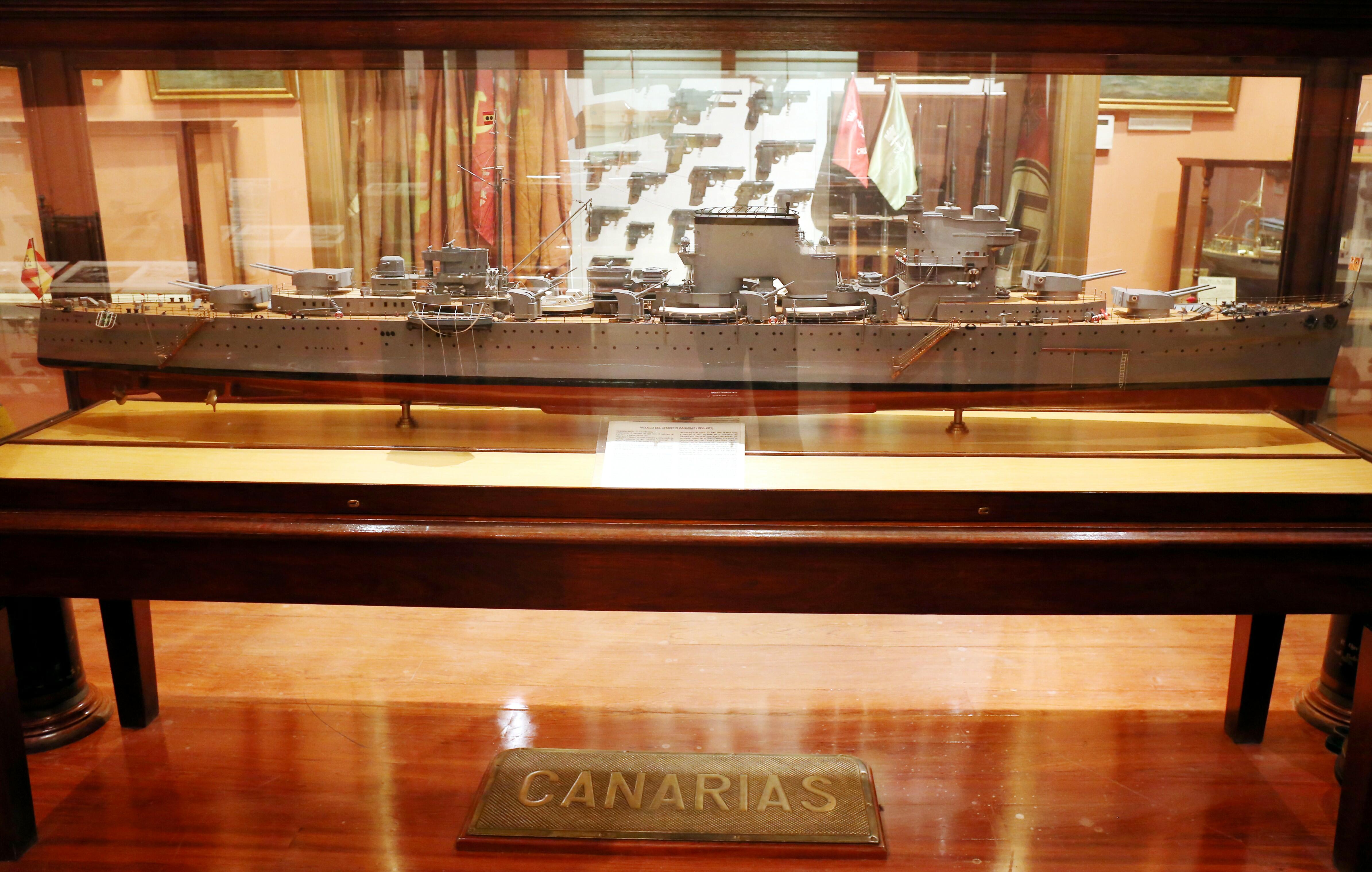
The photo shows a model of the cruiser Canarias in the Madrid Maritime Museum (El Museo Naval de Madrid), depicting the ship in its original form..