Narthex of Hagia Sophia
The next room is just as narrow and long as the exonarthex, but significantly wider and taller, and it is flooded with natural light from large windows under the vaults. Here we see a well‑preserved, luxurious finish on the walls and ceiling.
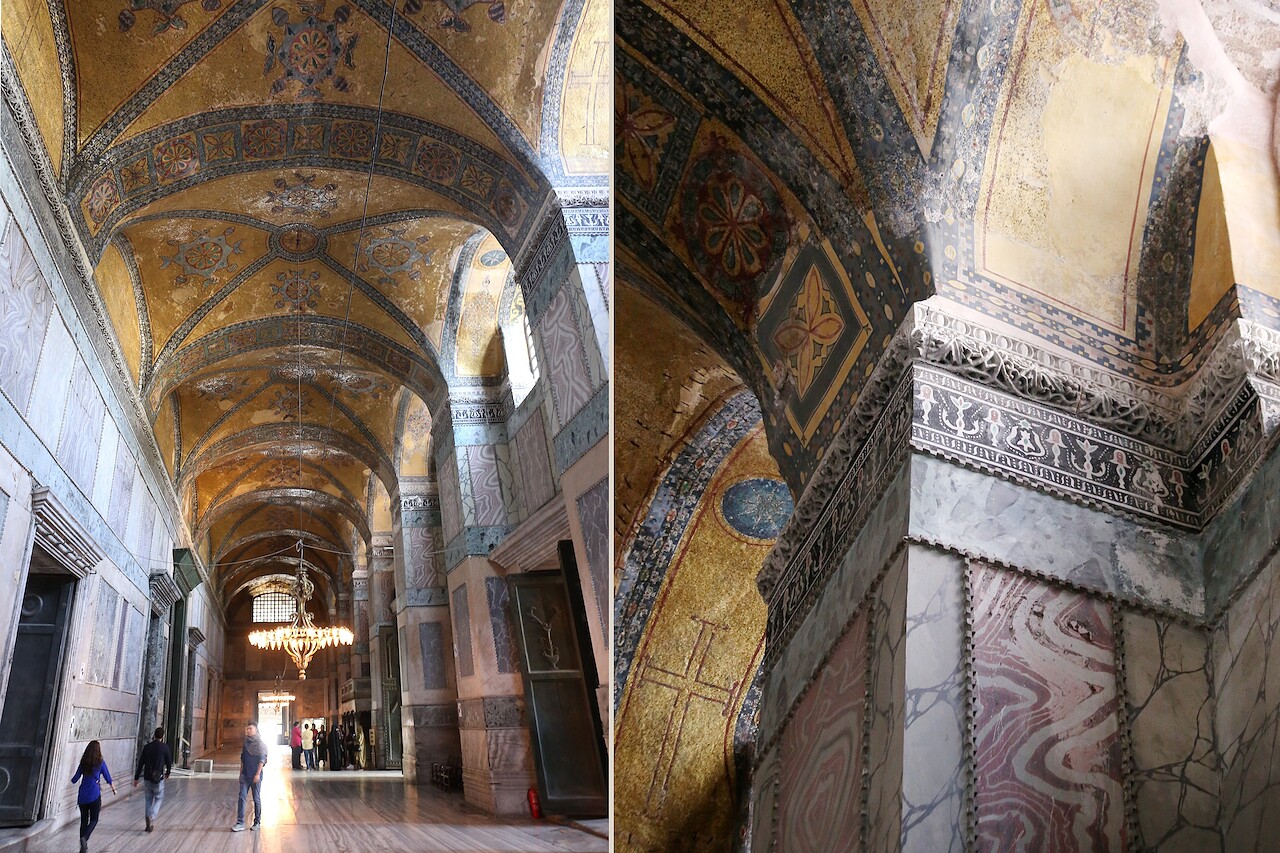
The ceilings are adorned with mosaics from the Justinian era (6th century) — golden fields with geometric and floral ornaments, without any human figures. Initially, all the walls of the church were decorated in this style. In the 8th century, during the period of iconoclasm, black crosses appeared on the golden fields.

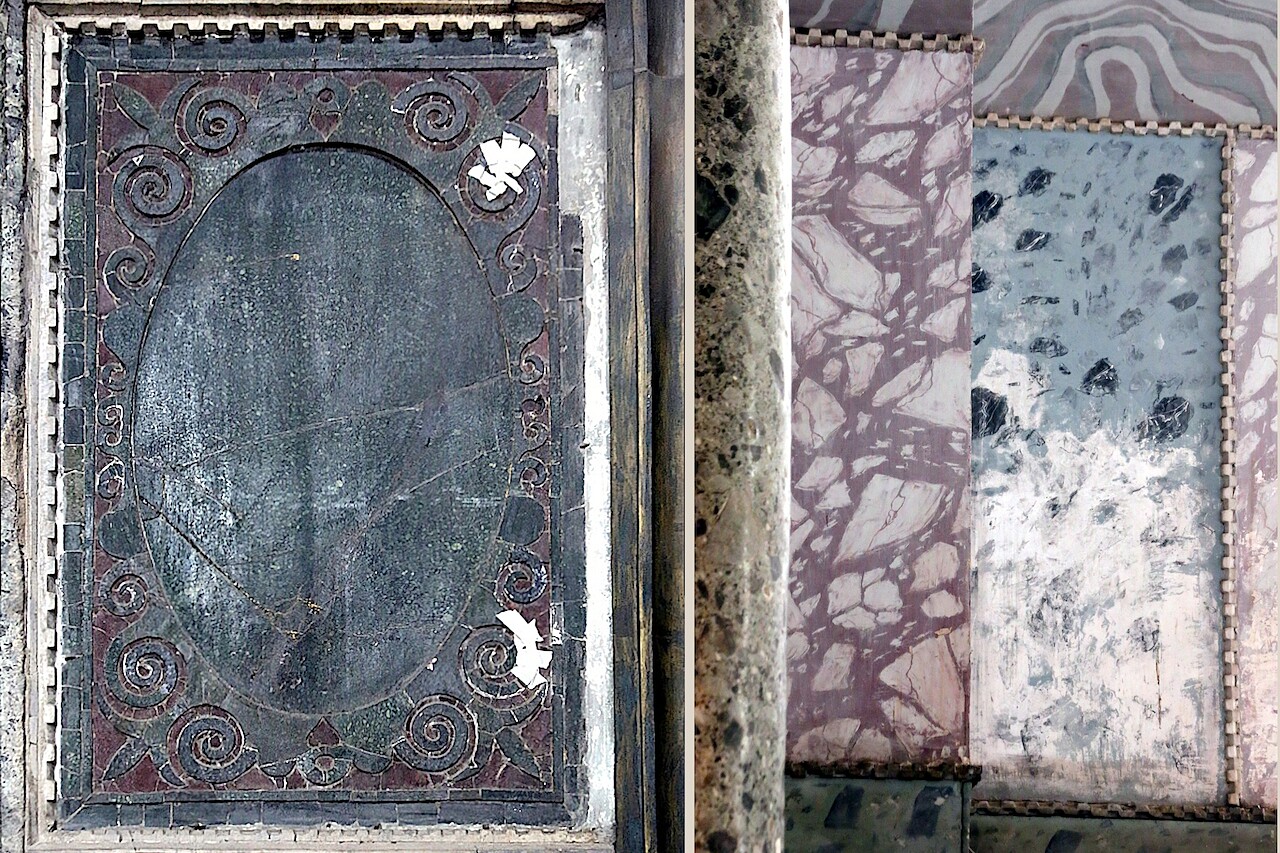
On the walls of the narthex, you can see magnificent marble panels, also created during the reign of Emperor Justinian. Large blocks of rare marble, brought from various quarries across the empire, were sawn into thin slabs and joined together in such a way that the natural vein pattern created symmetrical designs resembling fantastic creatures, waves, or flames. White Proconnesian marble, green Thessalian marble (from which the door surrounds are also made), and pinkish‑red porphyry are used here. Each marble panel is enclosed in embossed borders made of white marble, decorated with traditional Byzantine ornaments.
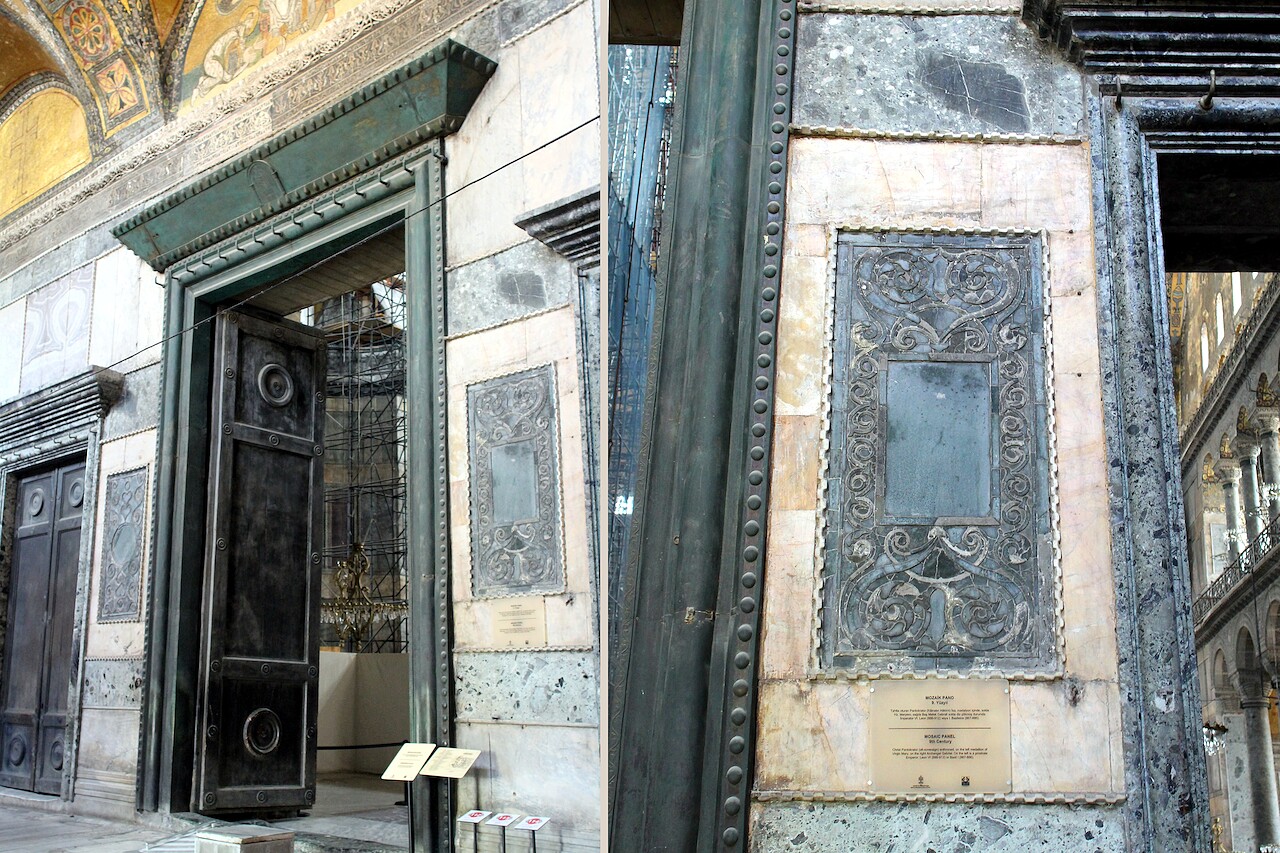
Five enormous doors lead from the narthex to the main nave. In the Byzantine era, ordinary parishioners entered through the south‑western vestibule; this entrance was intended exclusively for the emperor’s solemn processions with his retinue. The massive door panels are made of oak, framed with heavy bronze and metal fittings, and the doorways themselves are carved from green marble. The central doors are 7.6 metres high and 4 metres wide; they are the largest doors in the cathedral, and only the emperor had the right to enter through them, which is why they bear the appropriate name — “Royal Gates”. According to Byzantine legends, the wooden panels for these gates were made from remnants of Noah’s Ark. Initially, they were covered with silver, and their silver handles had a miraculous property: touching them with the tongue caused vomiting, and this procedure was carried out if poisoning was suspected. The real doors were stolen by the Crusaders in the 12th century, what we see now was made in 1849. The other four doors were called "Beautiful", through which civil officials from the imperial retinue entered.
Above the Imperial Gates is a mosaic created in the early 10th century. Jesus Christ Pantocrator (the Almighty) sits on the throne. He blesses with his right hand and holds an open Gospel in his left, where the Greek text is visible: “Peace be with you. I am the light of the world,” which is a combination of two quotations from the Gospel of John. On either side of Christ, in round medallions, are half‑figures: the Mother of God, raising her hands in prayer, and the Archangel Gabriel. To the left of Christ is Emperor Leo VI, who has fallen prostrate in a deep prayerful bow, extending his hands towards the Saviour. One might think that the meaning of the mosaic is that the emperor is merely a servant of Christ. However, such images cannot but carry a hidden meaning, and here historians’ opinions are divided. Some believe that the composition emphasizes the idea of theocracy: the Byzantine basileus receives his earthly power directly from Christ and is his faithful servant on earth. There is also a purely secular interpretation: As a result of three marriages, the emperor never had an heir, and in desperation, he decided to make his mistress, who had given birth to his son, his lawful wife. This violated church canons, which prohibited more than three marriages. A scandal erupted, and on Christmas Day in 906, Patriarch Nicholas Mystikos stood at the Royal Gates and did not allow Leo VI into the church. The emperor was taken aback and threw himself to the ground in tears. After weeping, the emperor entered through the side doors, and a few days later he deposed the Patriarch. After the death of Leo VI, Nicholas Mystikos once again became patriarch, and the mosaic was created at his direction, depicting the triumph of faith—or rather, the patriarch’s personal triumph—and in the image of Christ, he meant himself.
