Hagia Sophia. Columns of the Lower Tier
Popular literature often states that the Hagia Sophia has 365 columns, but in reality there are 128 of them, although this figure is certainly impressive, considering that each column can be called a work of art. When Emperor Justinian I began building the grand Hagia Sophia, it turned out that many of the construction technologies of the Roman Empire were no longer available. Then Justinian ordered the use of ready‑made architectural elements from ancient pagan temples. This practice has existed on various scales throughout history, and such elements are called “spolia”.

Upon entering the main nave, to the right and left in the exedrae (a semicircular niche with a semi-dome) we see pairs of columns made of dark red porphyry; the same type of columns; four more of the same columns are located in the exedrae of the altar section. The 10th‑century “Tale of the Construction of the Hagia Sophia” contains the following story about the origin of these columns: they were made in the mid‑3rd century AD by order of the Roman Emperor Aurelian for the construction of the Temple of the Sun (Templum Solis). At the end of the 4th century, Emperor Theodosius banned paganism, the temples were closed, and the materials from them began to be used for other construction projects. In the 6th century, the plot with the ruins of the Temple of the Sun came into the possession of the noble Roman widow Marcia, who received it as a dowry. The pious woman donated the columns from the temple ruins for the construction of Hagia Sophia, and they were transported from Rome by sea on specially built catamarans.

Between the main supporting pillars, on the southern and northern sides of the nave, we see four columns made of green Thessalian marble. Guides like to tell tourists that these columns come from the famous Temple of Artemis in Ephesus, which was burned down by Herostratus. However, this version raises doubts: this material is widely used in the decoration of the cathedral and is readily available in deposits around the Sea of Marmara. If porphyry columns ceased to be carved in the mid‑5th century, then the Thessalian columns were most likely made by stonemasons from Constantinople.
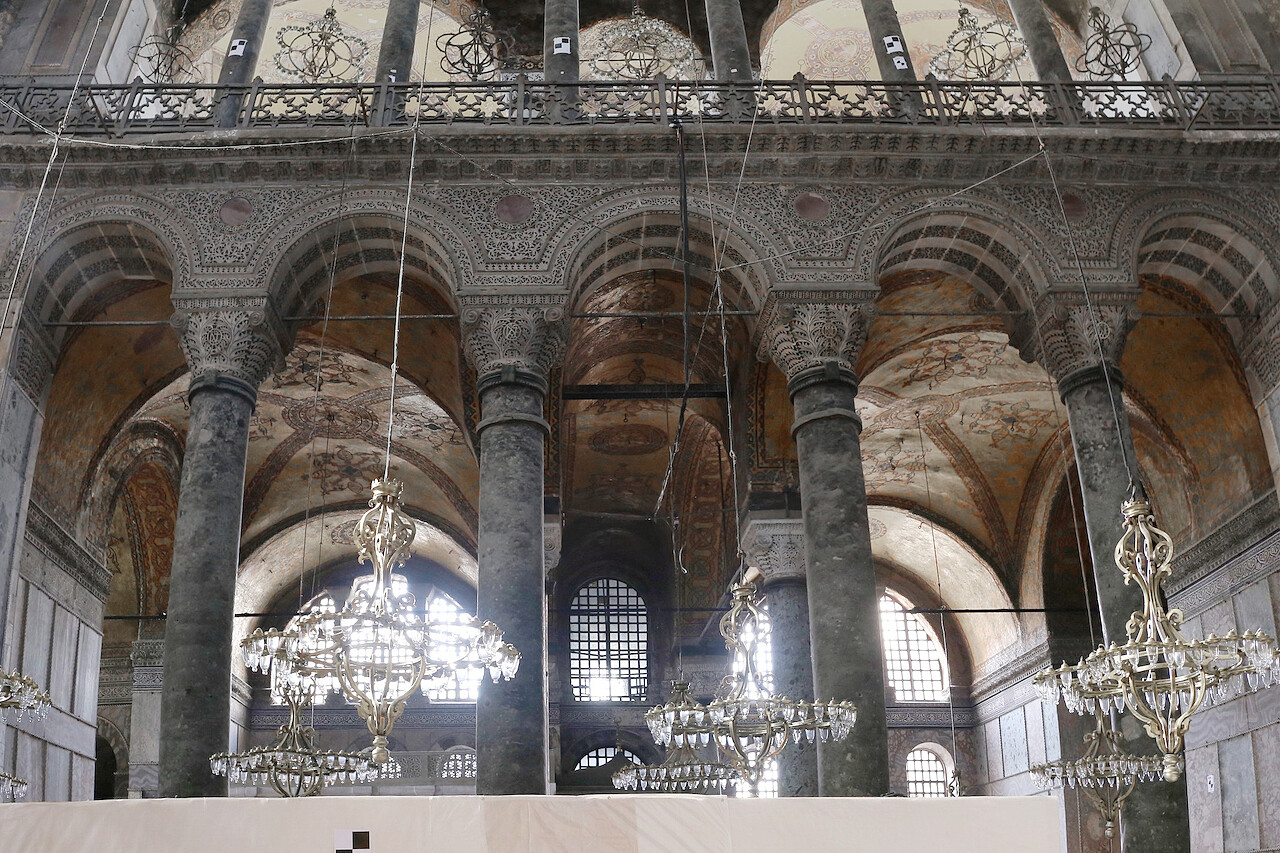
At the top and bottom of many columns, we can see bronze rings (collars) that protect the columns from cracking during underground tremors. One of the porphyry columns did crack and is reinforced with several rings — porphyry is an incredibly hard material, but at the same time it is very susceptible to impact loads. On one of the columns made of green marble, you can see a cracked lower ring. Such breaks began during the construction, and the architects had to urgently revise the design of the arches and dome to reduce their weight. The cracked rings could not be removed, as the solid bronze continued to perform its function; the cracks were filled with an elastic mortar.

Some of the upper rings of the columns are connected by ties. The main problem with dome‑shaped buildings is lateral thrust. Heavy arches and semi‑domes exert pressure not only downward but also sideways, seeking to push the columns apart. Metal ties work in tension: they firmly connect the supports to each other, holding them in a strictly vertical position.
