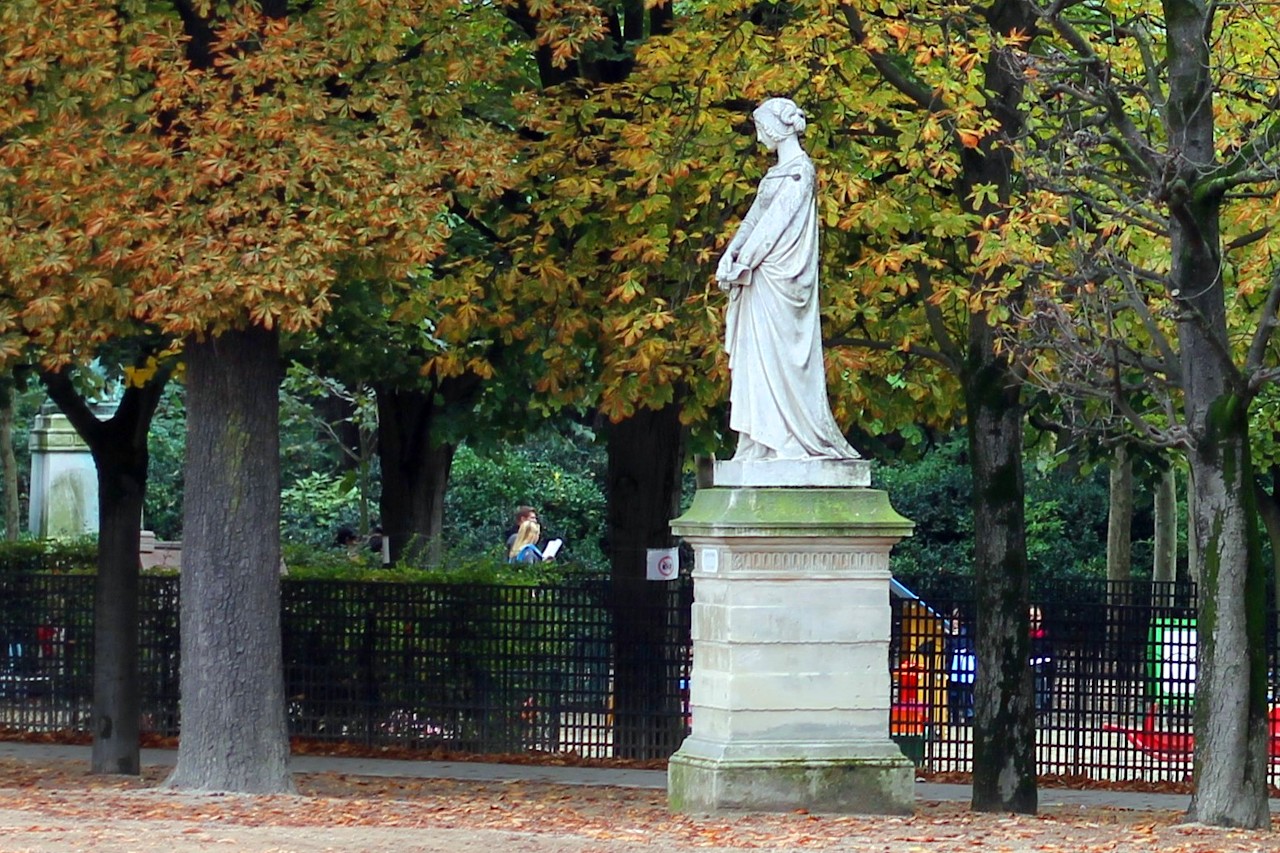
Great Women of France Scuptures in Luxembourg Garden
The terraces of the large pool are adorned with 20 statues from the cycle “Queens of France and Famous Women” (Reines de France et Femmes illustres). They were made and installed in the second half of the 1840s during the large‑scale reconstruction of the garden. This major state, political and artistic project was conceived as a visual chronicle of French history. The initiative to create this open‑air portrait gallery came from King Louis‑Philippe I, who came to power as a result of the July Revolution. He was driven not so much by a love of art as by quite pragmatic interests: to reconcile the divided French society - the Bonapartists, royalists, and republicans. One way to do this was to glorify France’s common great past. At the king’s direction, a grand series of statues titled “Famous Men” (Hommes illustres) appeared on the facades of the Louvre Palace, and for women, the Luxembourg Garden — the main public space in Paris — was very cleverly chosen. King Louis‑Philippe personally approved the list of women; the selection criterion was not merely nobility, but the significant mark left on the history, culture, or spiritual life of France. The final list included 20 historical figures, divided into several условные groups: patron saints, influential regent queens, and women who became symbols of culture. Orders for sculptures began to be distributed by the French Ministry of the Interior starting in 1843. Leading and promising French sculptors of that time were involved in the work. Each statue, made of high‑quality white Carrara marble, cost 12,000 francs — a huge sum for those times. The finished works were first exhibited at the prestigious Paris Salons of 1847 and 1848, after which they were transported to the Luxembourg Garden. By 1848–1850, the ensemble was almost completely completed.

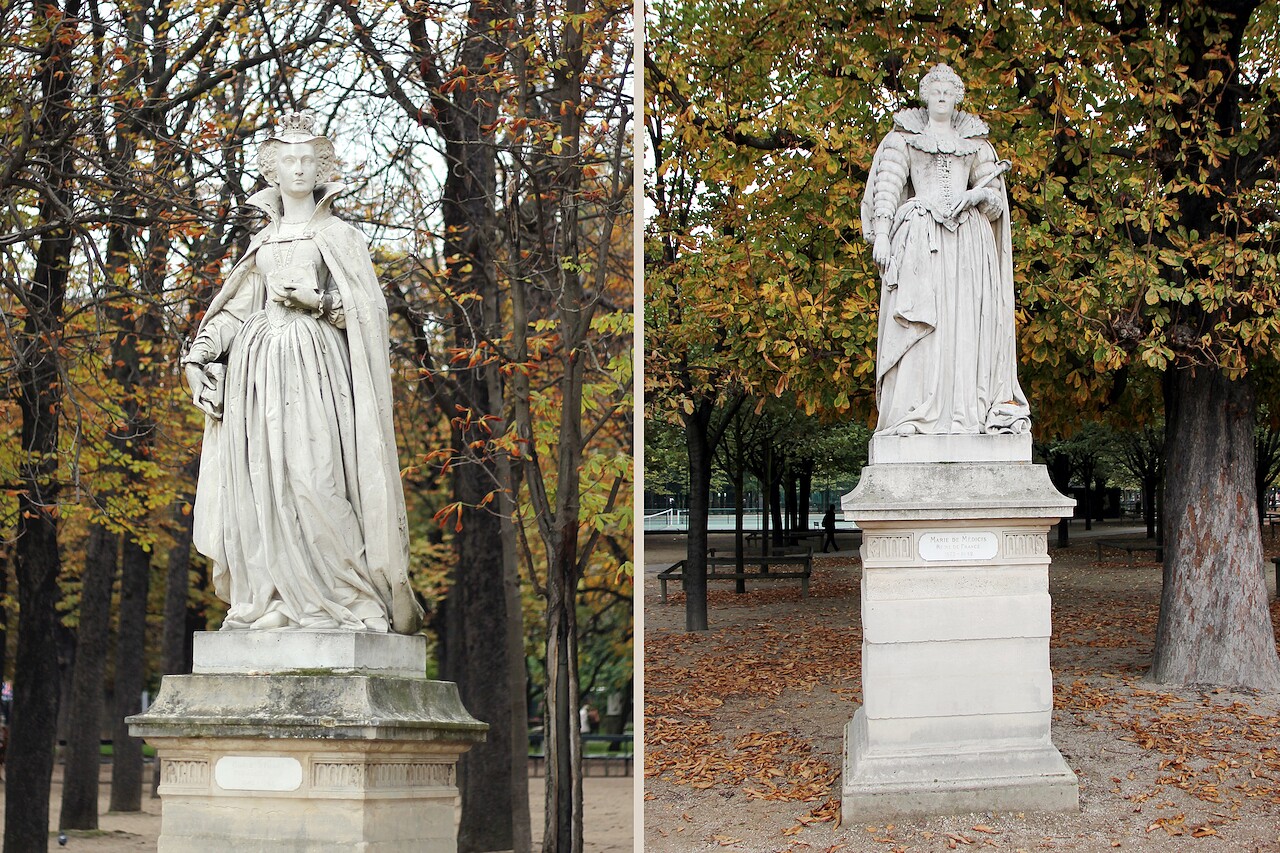
One of the most famous statues depicts Marie Stuart. Jean-Jacques Feuchère made it in 1846. The sculptor depicted Maria in a magnificent royal dress with a distinctive high ruff collar and a small crown on her head. She holds a book in her left hand near her chest, and with her right hand she holds the hem of her heavy cloak decorated with heraldic lilies.
On the right side of the photo you can see the marble sculpture of Marie de Medicis, Queen of France and regent for her infant son Louis XIII. The author is the French sculptor Louis-Denis Caillouette, the monument was completed in 1847. Marie de' Medici is a key historical figure for the Luxembourg Gardens. It was by her royal decree that the luxurious Luxembourg Palace was built and this magnificent garden was laid out in the early 17th century, as the queen longed for her native Florence and wanted to recreate the atmosphere of the Italian Boboli Gardens in Paris.
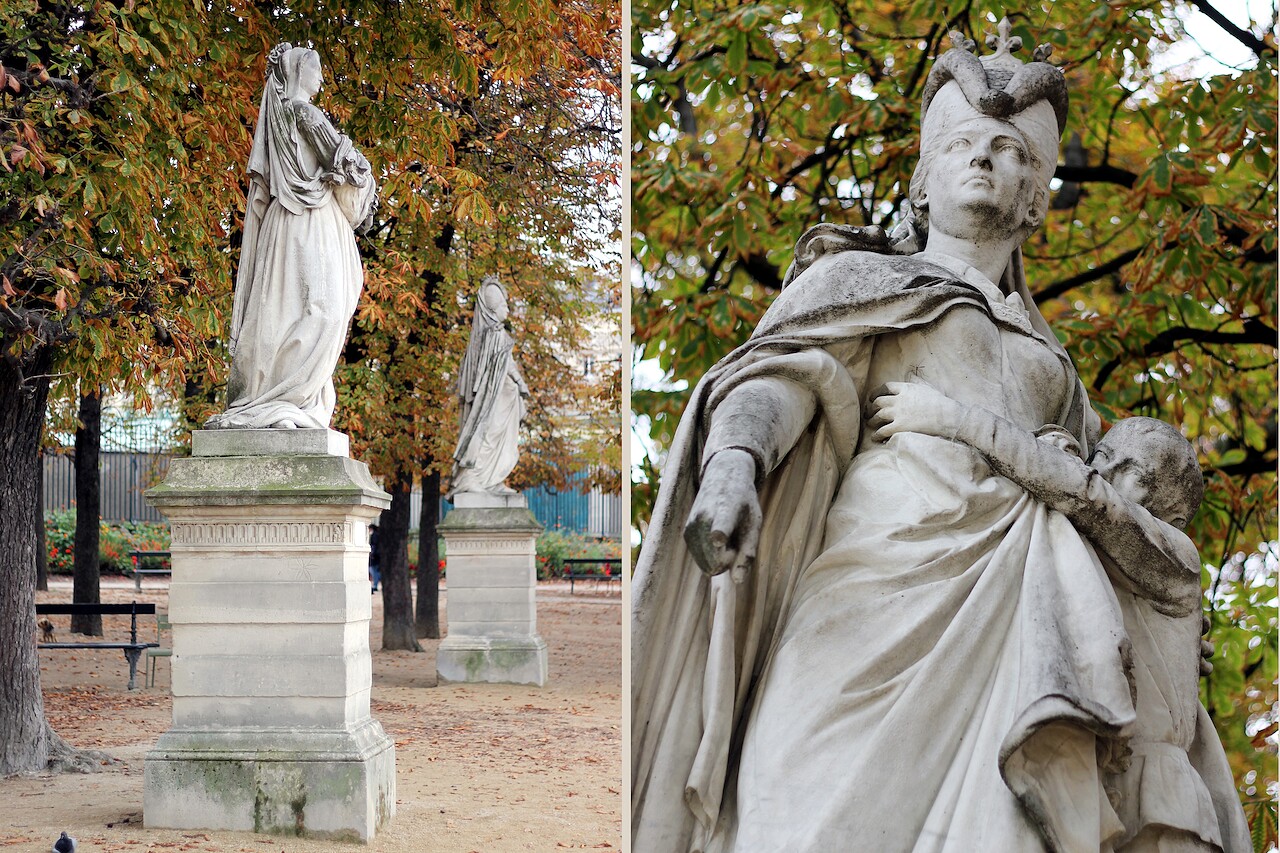
Louise de Savoie (1476–1531) was one of the most ambitious, calculating, and politically gifted women in French history. The mother of King Francis I, Louise devoted her entire youth and strength to paving the way for her son to the throne. She effectively governed the country as regent while her son was fighting in Italy. The second time she took the reins of power was at the most critical moment for the country — when Francis I lost the Battle of Pavia and was captured by the Spaniards, as a result of which France found itself on the brink of collapse. Louise of Savoy managed to keep the situation under control and personally conducted the most difficult negotiations with Margaret of Austria, the aunt of the Spanish king and Emperor Charles V. The two women managed to reach an agreement and stop the bloody war, and in 1529 a peace treaty was signed in Cambrai, which went down in history as the “Peace of the Ladies”. The author of this monument was the famous and very temperamental French sculptor Auguste Clésinger, who completed the work in 1851.
On the right in the photo is a statue of Marguerite d'Anjou (1430-1482), a French princess who became Queen of England through her marriage to Henry VI. She went down in history as one of the most formidable, warlike and indomitable women of the Late Middle Ages. Margaret became a key figure in the bloody Wars of the Roses for the English throne. Her husband, King Henry VI, suffered from severe bouts of madness and was unable to govern the state. Margaret effectively took power into her own hands and personally led the royal faction of the Lancastrians against the Yorkists. Unlike most medieval queens, she did not merely weave intrigues in castles; she personally gathered troops, conducted negotiations with Scottish and French mercenaries, and even appeared on the battlefields, inspiring the soldiers. Due to her stern temperament, historians and contemporaries often called her the “wolf queen.” Margaret desperately fought for the future of her only son, Edward of Westminster, in order to pass the crown to him. However, in the decisive Battle of Tewkesbury (1471), the Lancastrian forces were utterly defeated, and the 17‑year‑old Prince Edward was killed in battle. Margaret herself was taken prisoner and imprisoned in the Tower of London. Several years later, she was ransomed by her cousin, the French king Louis XI. Marguerite returned to France completely broken, having lost her family and her kingdom, where she spent the rest of her days in poverty. The white marble statue was created by French sculptor Ferdinand Taluet in 1874. This is one of the most dramatic compositions in the entire park. The Queen is depicted in a moment of deep grief and despair.: She protects and hugs her only young son Edward tightly to her. An interesting fact is that a statue of Joan of Arc originally stood on this pedestal.'The arch was created by François Rude, installed in 1852 according to the original list of great women. However, the marble from which it was carved turned out to be very sensitive to atmospheric influences, and the statue began to collapse. To preserve the monument, it was sent to the Louvre, and a statue of Marguerite of Anjou was commissioned and installed to replace it.
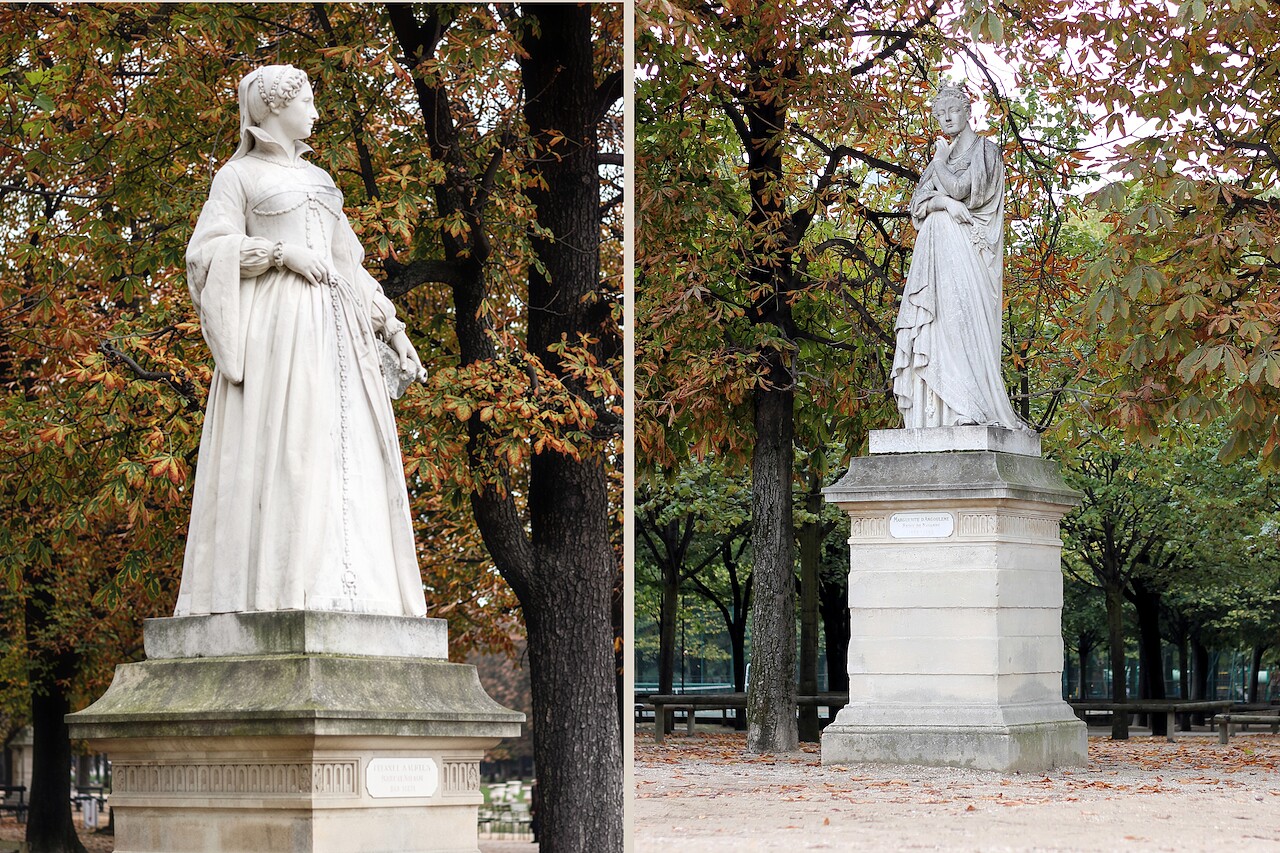
The statue of Jeanne d’Albret (Jeanne d'Albret, 1528–1572), also known as Jeanne III of Navarre. She went down in history as one of the most strong‑willed, independent, and influential women in 16th‑century France. Her son, Henry of Navarre, who would later ascend the French throne, put an end to the protracted Wars of Religion, issued the Edict of Nantes granting religious tolerance, and became the founder of the Bourbon royal dynasty in France. Jeanne was a devout Protestant (Calvinist). In the midst of the civil wars in France, she turned her kingdom of Navarre into an official stronghold of Protestantism. She personally oversaw the fortification and defense of the rebellious city of La Rochelle, conducted diplomatic negotiations, and financed the army. After becoming queen, she implemented large‑scale economic and religious reforms, translated the New Testament into the Basque language, and opened numerous schools, making her small Pyrenean state a cultural center. Jeanne engaged in a long‑standing ideological and political duel with the powerful Queen Mother of France, Catherine de’ Medici. In an attempt to broker peace between Catholics and Protestants, they agreed on the marriage of their children — Henry of Navarre and Margaret of Valois (the future “Queen Margot”). Jeanne d’Albret died suddenly in Paris at the age of 44, just two months before the wedding, which ultimately turned into the bloody St. Bartholomew’s Day massacre. Her sudden death gave rise to a persistent historical legend that Catherine de' Medici poisoned her with poison-soaked perfumed gloves. Modern historians, however, tend to believe that the queen died of tuberculosis. The monument to Jeanne d'Albret was created by the French sculptor Jean-Louis Briand in 1848. The sculptor depicted the Queen of Navarre in a characteristic austere Renaissance outfit — with a high collar, in a traditional headdress adorned with pearls, and holding a rosary in her hands, which underscores her deep religiosity.
On the right is Marguerite of Angoulême (Marguerite d'Angoulême, 1492–1549), also known as Margaret of Navarre. The writer, poet, and one of the most educated women of her time (the author of the famous collection “Heptameron”) is depicted in an elegant Renaissance‑era dress. She is frozen in a refined, contemplative pose, pressing her right hand to her chin, and in her left hand she holds an elegant daisy flower — a symbol of her name. The sculptor is Joseph‑Stanislas Lescorné (Joseph‑Stanislas Lescorné), 1848.
Laura de Noves (Laure de Noves, 1307–1348) entered world history and culture as the great muse of the outstanding Italian poet Francesco Petrarch. The poet first saw the 20‑year‑old Laura during a church service in Avignon on April 6, 1327. He instantly and unrequitedly fell in love with her for the rest of his life. At that time, Laura was already married to an ancestor of the famous Marquis de Sade. It was to her that Petrarch dedicated his immortal sonnets, which formed the famous collection “Canzoniere” (Book of Songs). Thanks to this platonic romance, the image of Laura became an absolute symbol in European culture of pure, sublime, and unattainable love. Laura was a mother of many children and died at the age of about 41, presumably during the plague epidemic that devastated Europe in 1348. Petrarch mourned her until the end of his days and continued to write poems in her honor even after her death. The monument to Laura de Nouveau was sculpted by the French sculptor Auguste Ottin in 1850. Laura is depicted in a graceful pose with her arms modestly crossed over her chest and in a flowing medieval dress with a cape, which refers to the aesthetics of the 14th century.