New Salwator Cemetery (Cmentarz Salwator Nowy), Gdańsk
On Stoczniowców Alley, in the lower part of the so-called Jewish Hill, where the long-closed Jewish cemetery is located, there is an active Christian cemetery. The fences of the two cemeteries are separated by Cmentarna Street (Cemetery Street), and there is a bus stop with the same name nearby. The cemetery was established at the turn of the century as a second burial plot for the Evangelical (Lutheran) community affiliated with the Church of the Saviour (Salvatorkirche); today it is known as the Church of the Saviour (Kościół Zbawiciela). The cemetery got its name from the parish.
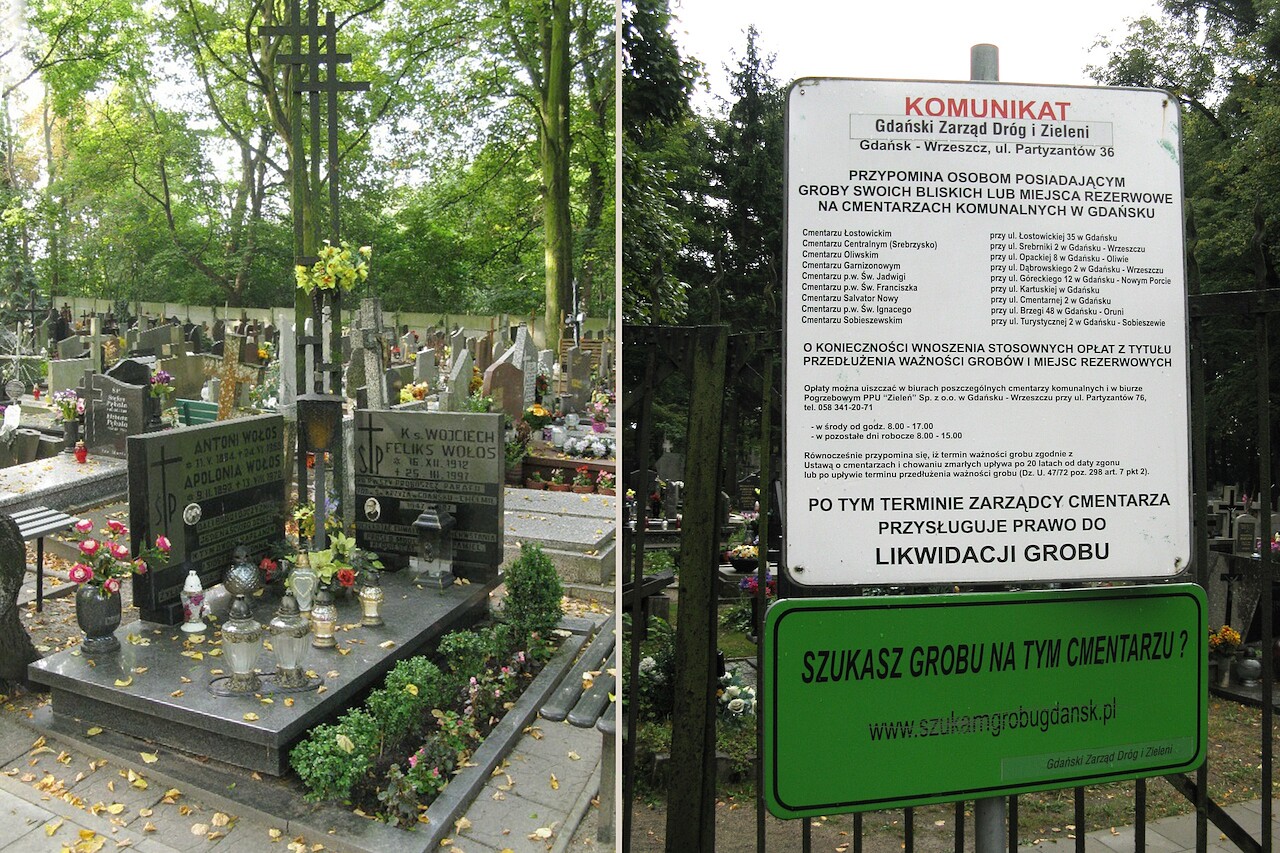
The exact date of its foundation is unknown, as most of the city and church archives burned down at the end of World War II. It is only known, that it already existed at the beginning of the century. Initially, the territory of the necropolis was twice as large as the modern one and occupied 1.33 hectares, gradually expanding. The central lime alley formed a clear layout, dividing the cemetery into equal halves.

At the end of the war, a significant part of the German population fled from the Red Army, and when Gdańsk returned to Poland as a result of the Yalta agreements, the remaining Germans were deported to the Soviet occupation zone in Germany. In 1947 In 1991, the cemetery was transferred to the civil administration and acquired the status of a municipal cemetery in Gdansk. In 1954 , the authorities decided to eliminate the abandoned German graves, as a result, the area of the necropolis was reduced by half. Now only post-war tombstones with Polish surnames can be seen here. Today it is a quiet and compact working cemetery.

Recently, due to a shortage of burial spaces, the authorities in Gdańsk decided to increase the available space by almost one hectare, which will make it possible to create about 1,000 new burial spaces, as well as to build an updated alley, a parking lot, and a fence.

Poles are generally religious and have a reverent attitude towards the memory of their ancestors; it is customary for them to visit graves no less than once every three months, as well as during church memorial days. The alleys and graves are very well‑maintained; I was particularly struck by the shelf with cleaning equipment, which would have been immediately taken away by our people.

.Candles in glass jars are constantly burning on the graves. When I was returning home at night, the area, initially plunged into darkness and filled with numerous flickering lights, gave me an eerie and mystical impression. In Poland, cemetery candles are a crucial element of national and religious culture. They are called znicze. Unlike ordinary open candles, Polish ones are always placed inside special jars made of colored glass or plastic, which protect the flame from wind and rain and have holes for air to reach the flame. Paraffin or wax is poured directly into these jars; the wick is used very sparingly, and such candles can burn for several days.

However, at night the cemetery looks like it does after days of mass visits — there are surprisingly many lights. It turned out that instead of classic candles, many people now use LED lights that simulate a live flame. The burning duration of such candles depends on the battery capacity and usually lasts three months, but it can go up to a year.

Adherents of tradition consider such candles to be non‑canonical, but the majority of the population understands the environmental problems associated with the disposal of tens of millions of oil lamps and has largely switched to electric candles.
