Street urinal (Urinol)
At the southern wall of St. George’s Castle, at the end of Rua do Chão da Feira, there is a public urinal from the “Belle Époque” era. You can see it from afar by the beautiful wrought‑iron plaque with the inscription “Urinol”. Such sanitary facilities are not uncommon in Paris or Amsterdam, but seeing such an object in Portugal was quite unexpected for me.
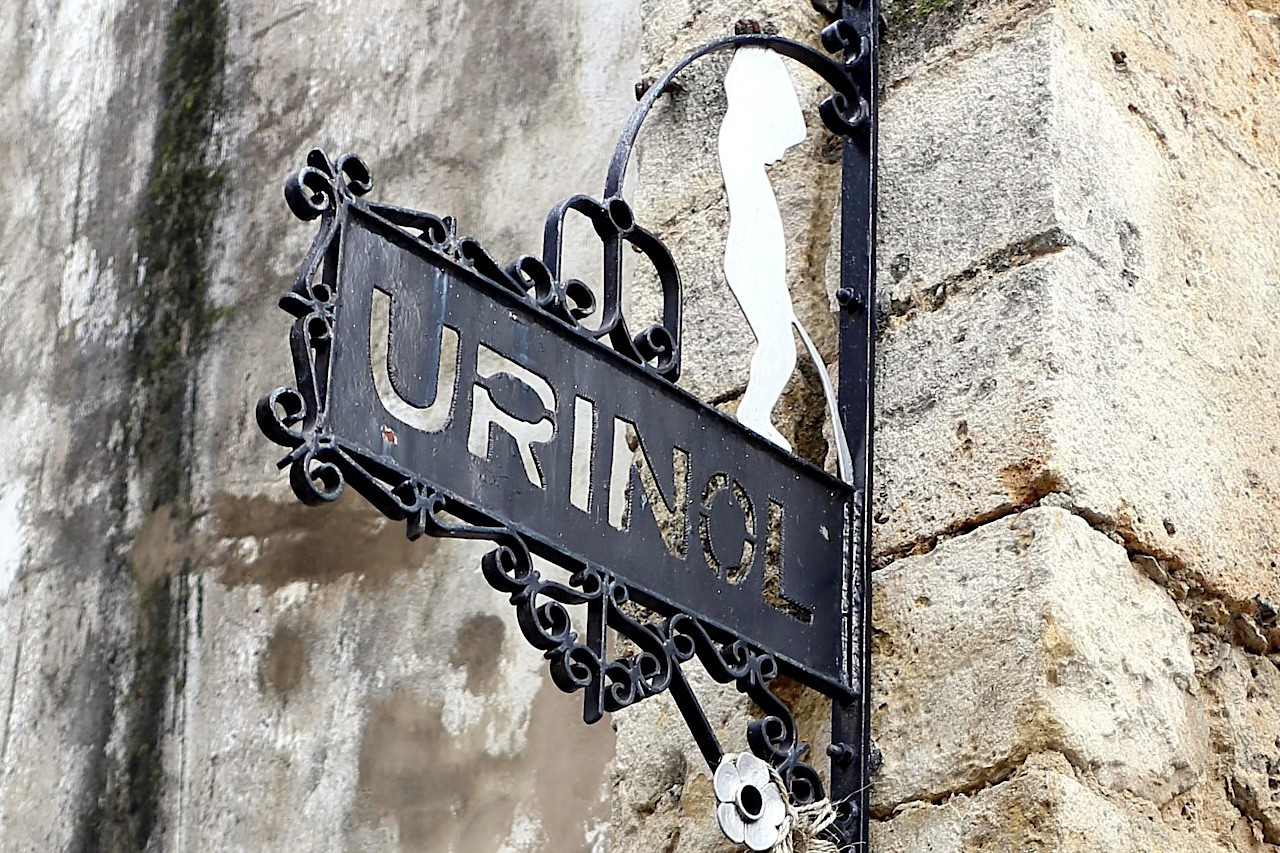
Contrary to the common belief that the ancient Romans were the first to build public toilets, traces of similar structures with flushing water date back to the 25th century BC; archaeologists have discovered them in India and Pakistan. The Romans merely made visiting these places one of the components of the overall hygienic culture and even profited from it. While the state built large public latrines, so to speak, of a “full cycle,” and there were relatively few of them, private individuals monetized the practice of relieving oneself: under Emperor Vespasian, vessels for collecting urine began to be placed in the streets of Roman cities; the urine was then sold to tanners for tanning leather and to laundries for bleaching fabrics. The emperor also did not stay aloof from this business and introduced a tax on this collection, uttering the historic phrase “money doesn’t stink”. With the decline of Roman civilization, this culture was forgotten for a long time and only returned to Europe in the early 19th century in response to the rapid urbanization, unsanitary conditions, and new ideas about propriety. The real revolution of street urinals began in Paris. To discourage men from relieving themselves on the walls of houses and trees, the authorities installed the first public urinals. These were cast‑iron structures, often round or semicircular in shape, which quickly became Paris’s calling card. By the 1930s, there were more than 1,200 of them in Paris. Initially, the walls of these structures served as billboard stands. Parisians began to call them “Vespasian” benches, in memory of that very emperor. Victorian England not only adopted this from its neighbors but also radically modernized it: At the 1851 World's Fair in London, George Jennings introduced the first paid public toilets with flushing urinals, which soon began to be built throughout the country. Because of the strict Victorian morality, the British preferred to hide urinals underground. The entrance was decorated with beautiful wrought iron grilles, and expensive materials were used inside: marble, polished granite, porcelain and patterned tiles.

In Portugal, street urinals of the French design began to be built at the end of the 19th century; local factories started producing structures made of cast iron and sheet iron, while not forgetting about the aesthetics that resonated with the Belle Époque - utilitarian fences were decorated with openwork metal elements and beautiful signs in the Art Nouveau style. As home toilets developed and hygiene standards changed in the 20th century, most of them were dismantled. A significant role in this was played by the feminist movement, which saw gender discrimination in devices designed for men. Now in Lisbon, apart from the urinal at St. Gorgias Castle, there are only three such structures left: at the Praça Viscondessa dos Olivais and the Praça David Leandro da Silva.