Teatro Politeama, History and Architecture
On Rua das Portas de Santo Antão, a block from Reshtauradores Square, there is a striking architectural monument, in the history of which the ambitions of patrons, the spirit of the young Portuguese Republic and the features of advanced European art of the early 20th century are closely intertwined. The idea of creating a new multigenre theater venue belonged to a major entrepreneur Luís António Pereira, a passionate lover of music and theater, who also financed its construction. The outstanding Portuguese modernist architect Miguel Ventura Terra was invited to design.
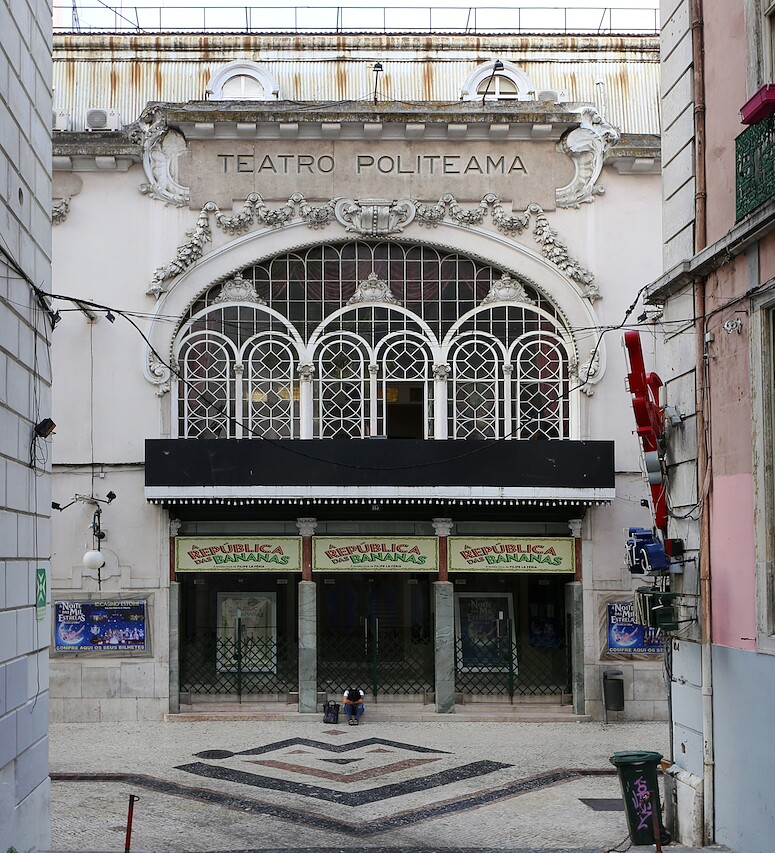
On May 12, 1912, the first stone was laid, and a year and a half later, on December 6, 1913, the grand opening of the new stage took place. The theatre was given a name that evoked antiquity; it consists of the Greek words “poly” (many) and “theama” (spectacle), emphasizing the versatility of the stage: comedies, dramas, operas were staged here, and it was also used for film screenings. It was the first theater built in Lisbon after the proclamation of the Portuguese Republic and the opening was attended by the first democratically elected President, Manuel de Arriaga. The debut production was the operetta "The Waltz of Love" (O Valsa do Amor) by the famous Viennese composer Carl Michael Ziehrer.

However, the theater’s fate was far from rosy: in the 1920s, public interest shifted to cinema, theatrical productions brought only losses, and from 1928, “Politeama” became an ordinary movie theater. In 1955, a fire broke out, damaging the luxurious interiors, and the theater lost its former prestige; in the 1970s and 1980s, television, and then the advent of VCRs, finally finished off the theater. In the late 1980s, the building was virtually abandoned and in a state of disrepair; the public had good reason to fear that it would be demolished to make way for commercial real estate. The unique facility was saved by the renowned director Filipe La Feria: between 1992 and 1994, he bought and completely restored the building, turning it into the main Portuguese stage for large‑scale musicals. The Portuguese "Maldita Cocaina", "Amalia", as well as the world-famous "My Fair Lady", "Music in the Heart", "Jesus Christ Superstar" were staged here. In 2002, the building was officially recognized as an object of public importance.

The building’s architecture is truly unique; here we can see both Art Nouveau and elements of Art Deco, which was just beginning to emerge at that time. Despite the innovative style, the building’s structure and the symmetry of the facade preserve the fundamental classical theatrical canons. The theatre’s interiors were created by renowned masters of the early 20th century: the sculptor Jorge Pereira and the artists Benvindo Seia and Veloso Salgado. The ceiling painting allegorically glorifies the union of Music, Dance, and Drama. The hall still carefully uses the historical front curtain, which was hand‑painted more than a century ago.
